


Okay, the title sounds a little grandiose. But perhaps rightly so. Let me give you a quick rundown of the main things we’ll explore in this article:
The Sun contains about 99.8 per cent of all the mass in our solar system. Yet our little Moon can completely cover its disc as seen from Earth: the Sun is about four hundred times wider, but also almost four hundred times farther away. Divide their distances from Earth by their own diameters, and both give a ratio around 108.
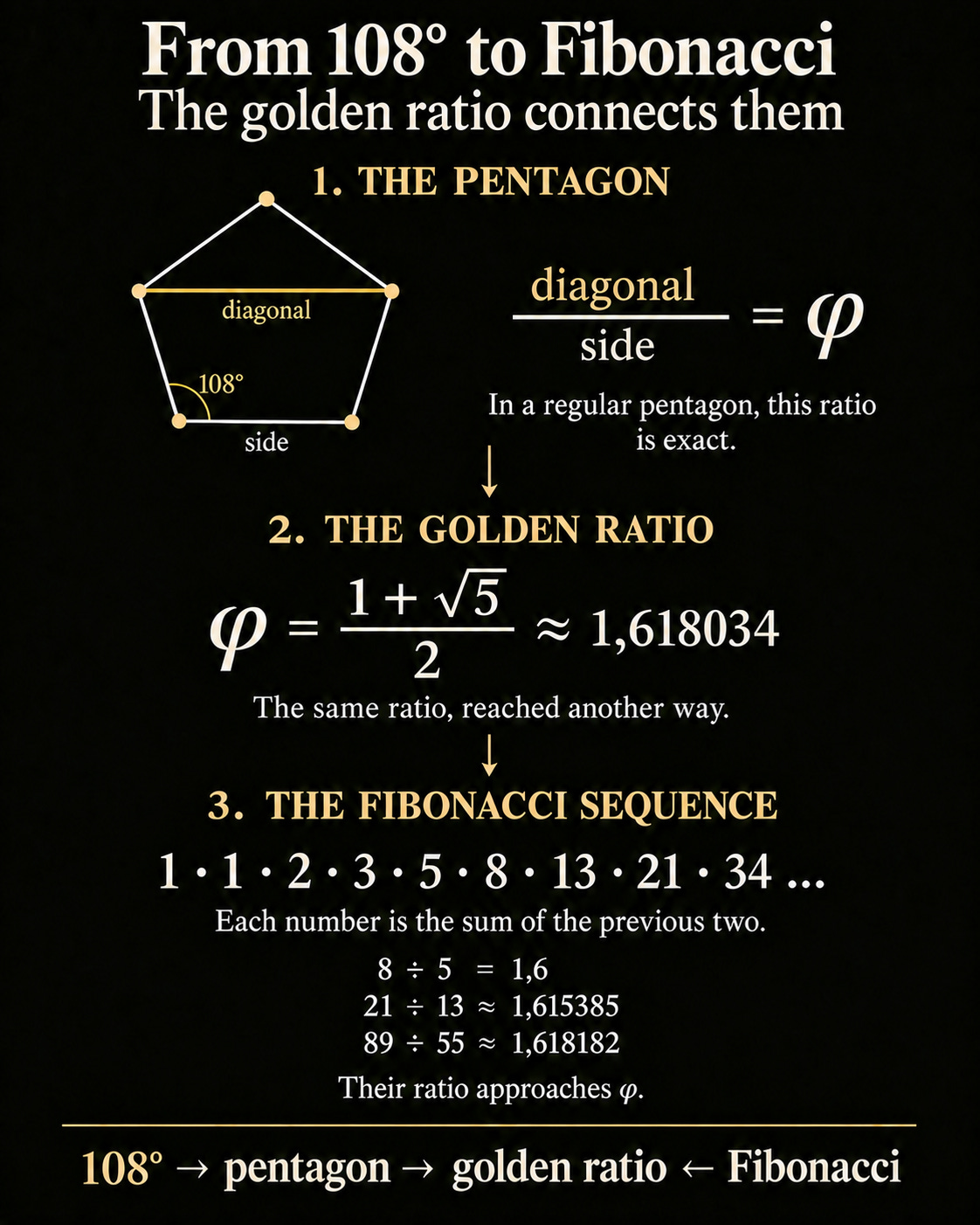
Every interior angle of a regular pentagon is 108 degrees. Join its vertices to form a pentagram and you find the golden ratio in the proportions between its lines.
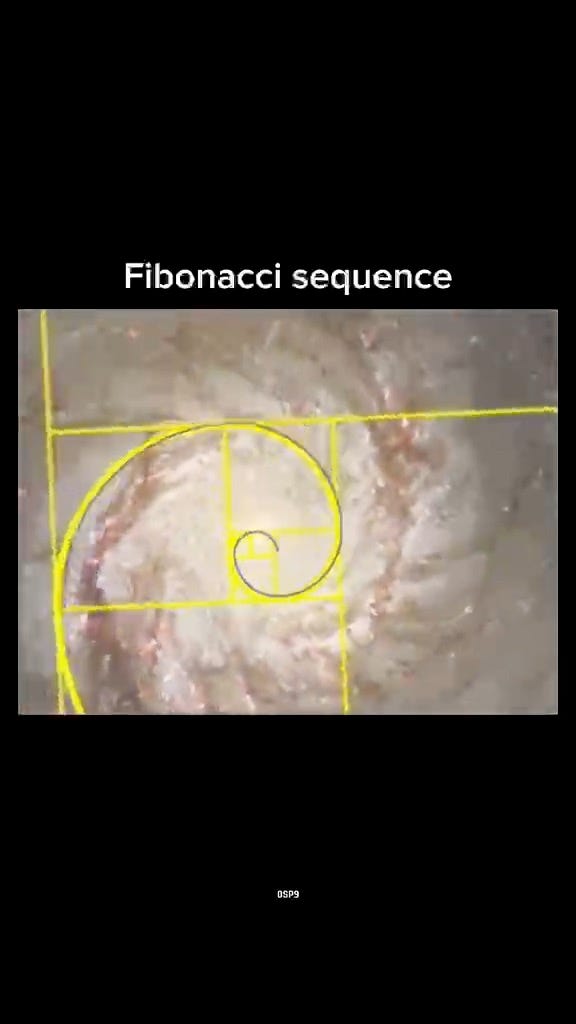
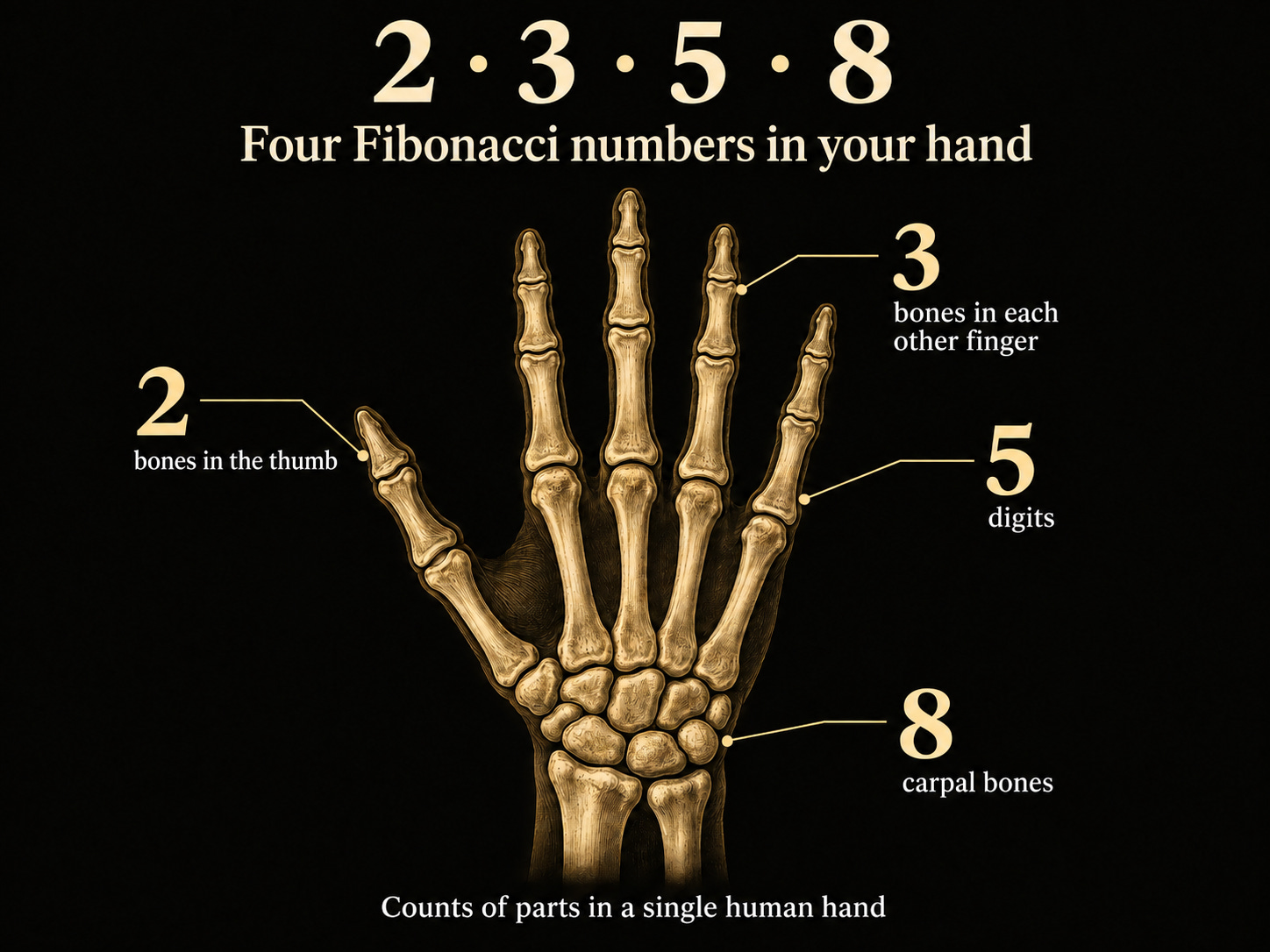
That connection takes us to the Fibonacci sequence. Divide consecutive numbers by one another and you approach the golden ratio. In sunflowers, these numbers often reappear in the number of spirals. Even your hand contains the counts 2, 3, 5 and 8.
Both the golden ratio and the pentagon were used in the Gasunie building in Groningen. Its two wings meet at 108 degrees. Proportion acquires walls, windows and a space you can walk into.
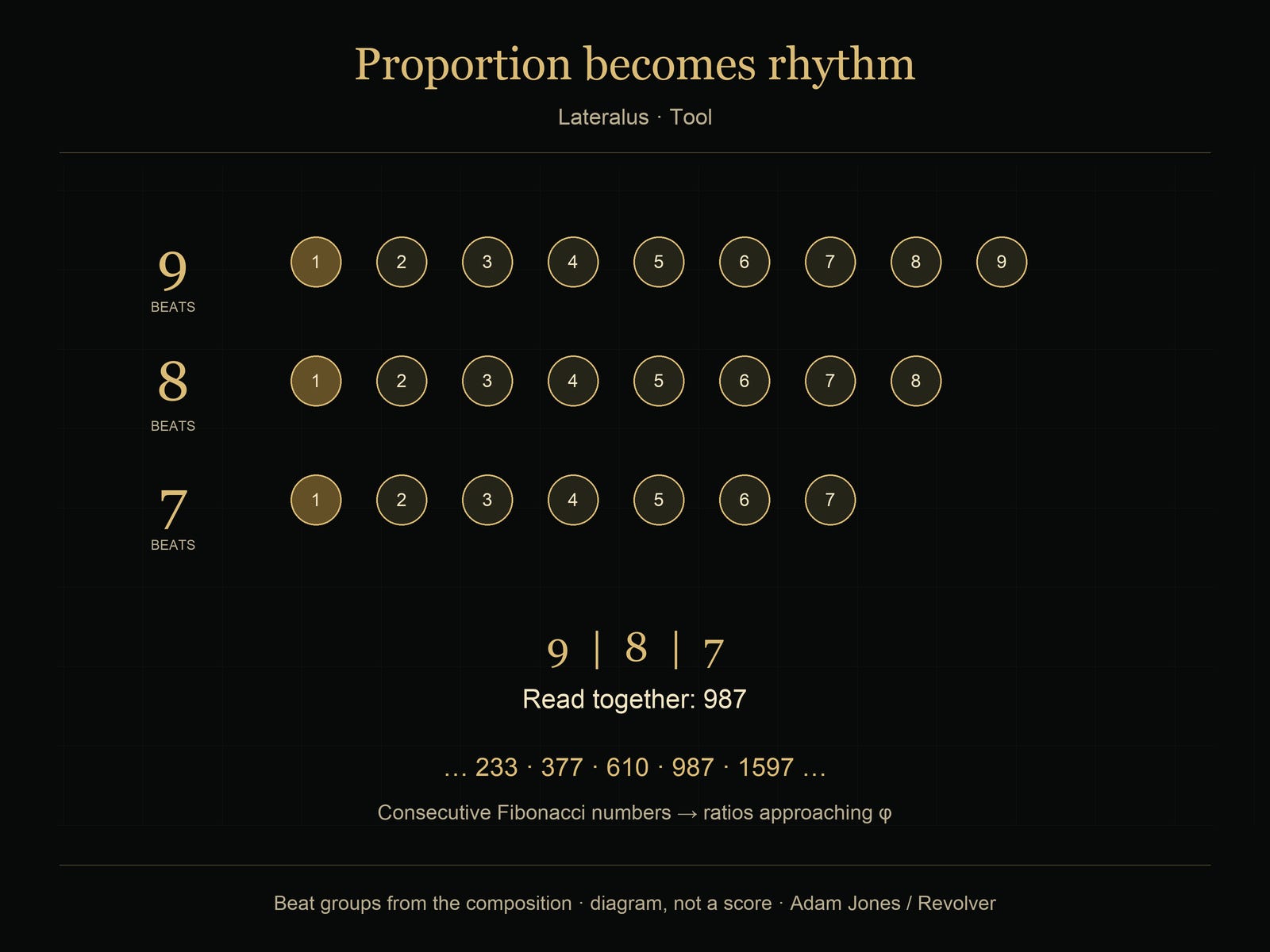
Proportion can also be heard. Double a note’s frequency and you hear an octave. In Tool’s Lateralus, Fibonacci also takes musical form: groups of 9, 8 and 7 beats, read together, form 987, a Fibonacci number, while parts of the vocals follow the sequence through their syllable counts.
Creation is built on proportion
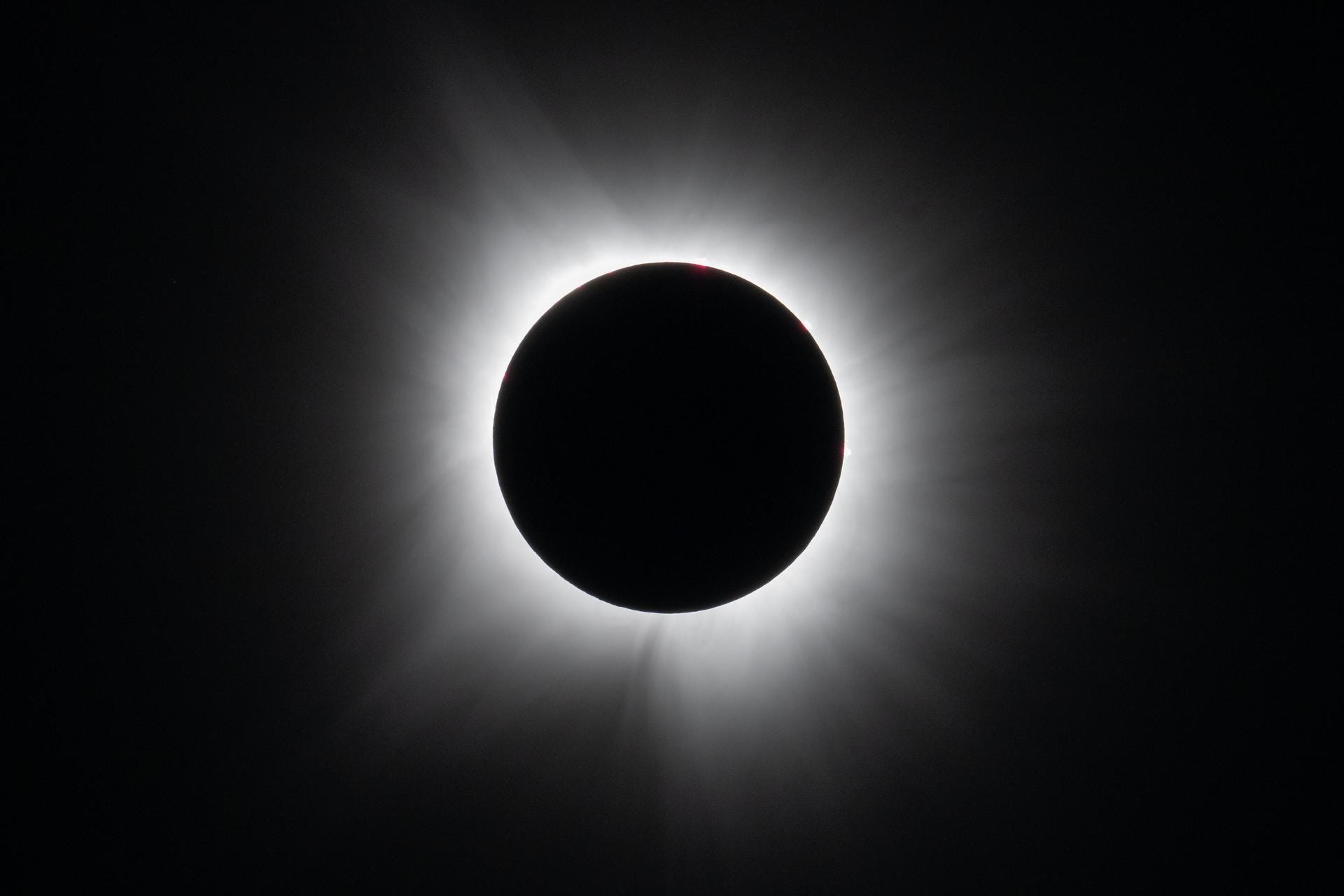
There are moments when the world, without explaining a thing, reclaims our attention. A solar eclipse (such as the one on 12 August) is one of them. People look up. Streets grow quieter. Someone points, someone else puts on eclipse glasses, children ask why the light is changing. For a few minutes, the most ordinary source of light, the Sun, becomes something strange. Not gone, but hidden. Not vanished, but beyond our ordinary way of seeing.
Humans aren’t the only ones who notice the day briefly tilting. Animals also respond to the changing light. Birds may fall quiet or look for somewhere to roost, while some nocturnal animals seem to wake for a moment. An eclipse shifts the rhythms of an entire environment, even if only for a few minutes.[^1]
An eclipse makes it clear that we do not stand outside nature. We are right in the middle of it, an inherent part of it: on a small Earth, moving around a star, with a moon that sometimes passes directly between us and the Sun. It is a natural phenomenon, and the more you know about it, the more extraordinary it becomes.
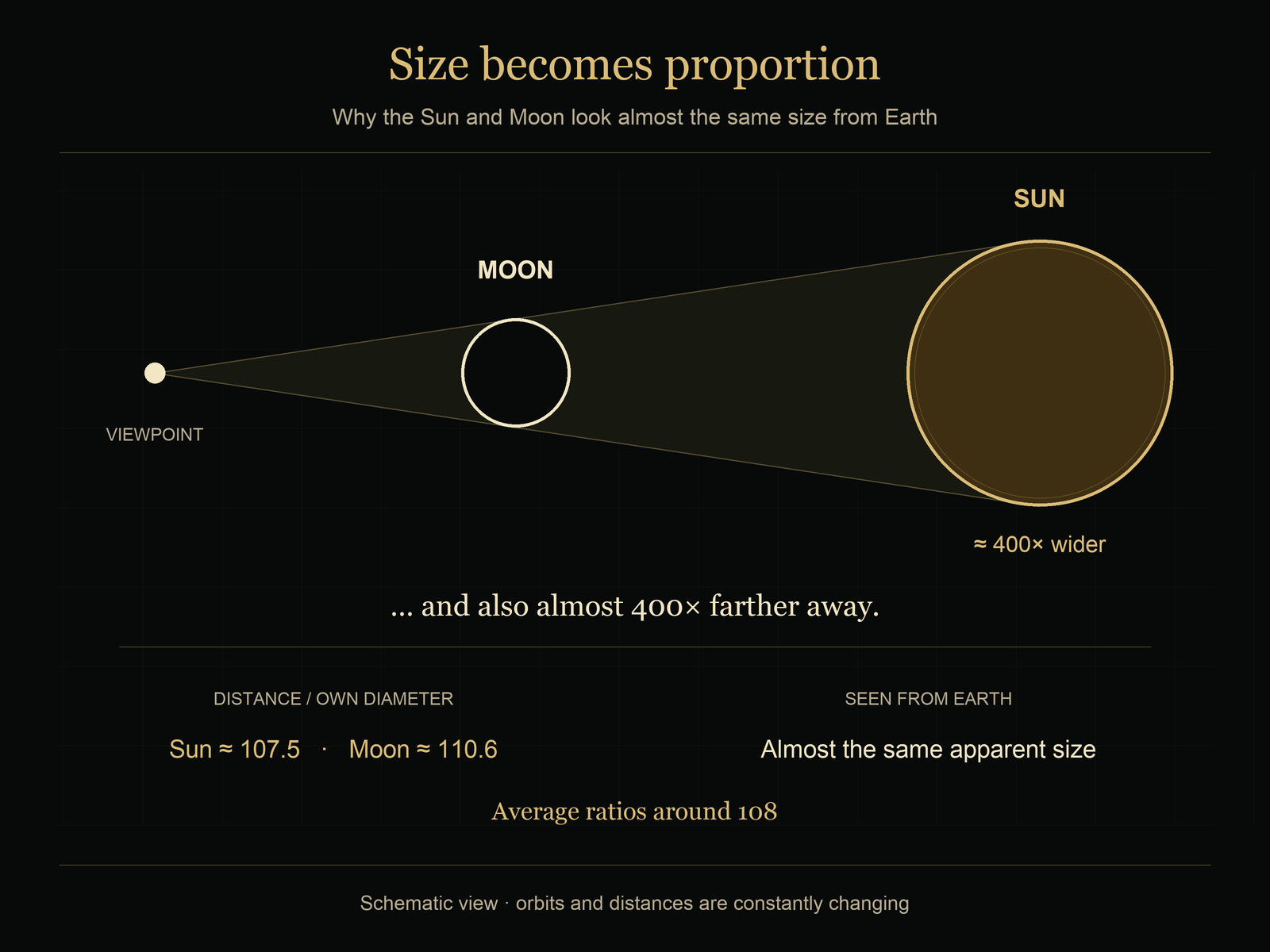
The scale alone is almost impossible to grasp. The Sun contains about 99.8 per cent of all the mass in our solar system.[^2] Earth, the Moon, the other planets, asteroids, comets and ourselves move within that tiny 0.2% of matter around it. The Sun is about four hundred times wider than the Moon, but also almost four hundred times farther away. From Earth, the two therefore appear almost the same size in the sky.
A total eclipse becomes possible when those two discs overlap. Not because they are actually the same size, but because, from this particular place, the difference in size and the difference in distance almost cancel each other out. Sometimes the Moon appears slightly larger than the Sun, and the Sun disappears completely. Sometimes the Moon is a little farther away, appears smaller, and leaves a burning ring visible.
Elsewhere in our solar system, moons also pass in front of the Sun. But nowhere do we know of the same almost perfect match in apparent size.[^3] Our Moon doesn’t crudely blot out the Sun with room to spare. It fits. Sometimes almost seamlessly.
What the actual fuck, we’re floating. Now. Right this moment. In what is, in all likelihood, an infinitely vast universe.
And somewhere in that peculiar relationship, a number appears that has been repeated in India for centuries.
The ratio in the sky
Here, 108 appears. Not merely as a number, but above all as a deeply intriguing ratio.
The average distance between Earth and the Sun is about 107.5 solar diameters. The average distance between Earth and the Moon is about 110.6 lunar diameters. Because both orbits are elliptical, these values change constantly. So 108 is not a physical constant engraved into the universe to the last decimal place.
But nothing in the material world stays still enough to retain exactly the same measured value forever. Earth moves. The Moon moves. The Sun moves. Distances breathe, as it were, with their orbits. The fact that 108 is not a flawless constant does not empty this convergence of meaning. It is the round figure under which two different ratios come strikingly close together.
After all: if you weighed every grain of sand on Earth and, go on then, on every planet in the universe one by one, you would discover that no two grains weigh exactly the same. More than that: you would discover that their weights all differ enormously. If, for example, you looked 1,000,000,000,000,000,000,000,000,000,000,000,000,000,000,000,000,000,000,000,000,000,000,000,000,000,000,000,000,000,000,000,000,000,000,000,000,000,000,000,000,000,000,000,000,000,000,000,000,000,000,000,000,000,000,000,000,000,000,000,000,000,000,000,000,000,000,000,000,000,000,000,000,000,000,000,000,000,000,000,000,000,000,000,000,000,000,000,000,000,000,000,000,000,000,000,000,000,000,000,000,000,000,000,000,000,000,000,000,000,000,000,000,000,000,000,000,000 digits beyond the decimal point, you would start to see the differences. While still being nowhere near even a grain of the infinity into which you could measure, of course.
Historian of Indian science Subhash Kak has proposed that 108 in Vedic cosmology and temple architecture relates to the distances to the Sun and Moon, expressed in their own diameters.[^4] In Vedic astronomical knowledge, the Sun and Moon are each approximately 108 of their own diameters from Earth. That is why they appear almost the same size from here. That is what makes this particular form of eclipse possible.
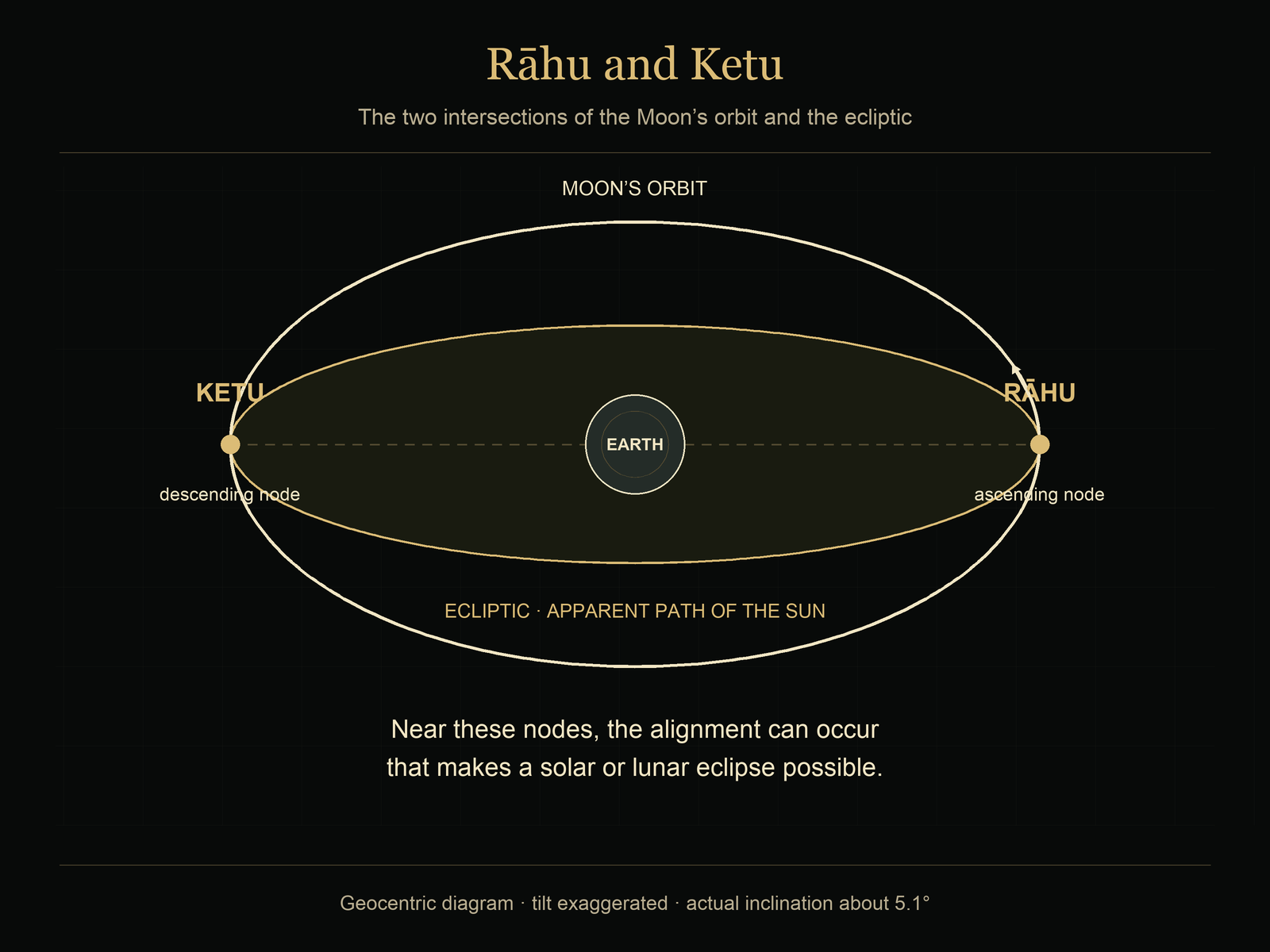
The Moon’s orbit crosses the Sun’s apparent path at two points: the lunar nodes. Eclipses can occur near these intersections.
The question is not only how people could have measured this back then. It is also why a civilisation would do more than record such a ratio, why it would let it return in prayer, movement and architecture.
A number that keeps turning up
For hundreds of millions of people, 108 is not some esoteric internet factoid. The number appears in malas with 108 beads, in mantras repeated 108 times, in the names of deities, in pilgrimages and temple traditions.
And it doesn’t stop at prayer. The Nāṭyaśāstra describes 108 karaṇas, movements from Indian dance that have also been carved into temple stone.[^5] Historical musical systems count 108 rhythmic cycles.[^6] Around Shiva, we find, among other things, 108 names and lingas bearing 108 smaller lingas.
Someone growing up within such a tradition doesn’t encounter 108 just once in a footnote. The number is counted, sung, danced, walked and touched. You’re practically bombarded with it. It is a form through which paying attention is practised.
Twelve times nine
108 is twelve times nine. Within Indian astrology, that multiplication takes a concrete form: each of the twelve zodiac signs is divided into nine smaller parts, the navāṃśas. Together, they form 108 divisions spanning the entire zodiac.
Twelve does not, of course, belong to India alone. The New Testament connects the twelve apostles with the twelve tribes of Israel; in Revelation, a city appears with twelve gates and twelve foundations. Different civilisations evidently recognised twelve as a number through which a complete order could be imagined: a year, a people, a heaven or a cosmos.[^7]
Twelve also appears in the building blocks of life. Carbon forms the chemical backbone of all life we know. The nucleus of its most common stable isotope, carbon-12, contains six protons and six neutrons: twelve nuclear particles. That twelve describes the physical composition of the nucleus. People then chose this atom as a standard of measurement: the atomic mass unit is defined as one twelfth of the mass of a single carbon-12 atom. A natural count thus became the reference point through which we express atomic masses.
108 is twelve and nine meeting: a whole and its finer divisions, brought together in a single number.
An angle of 108 degrees
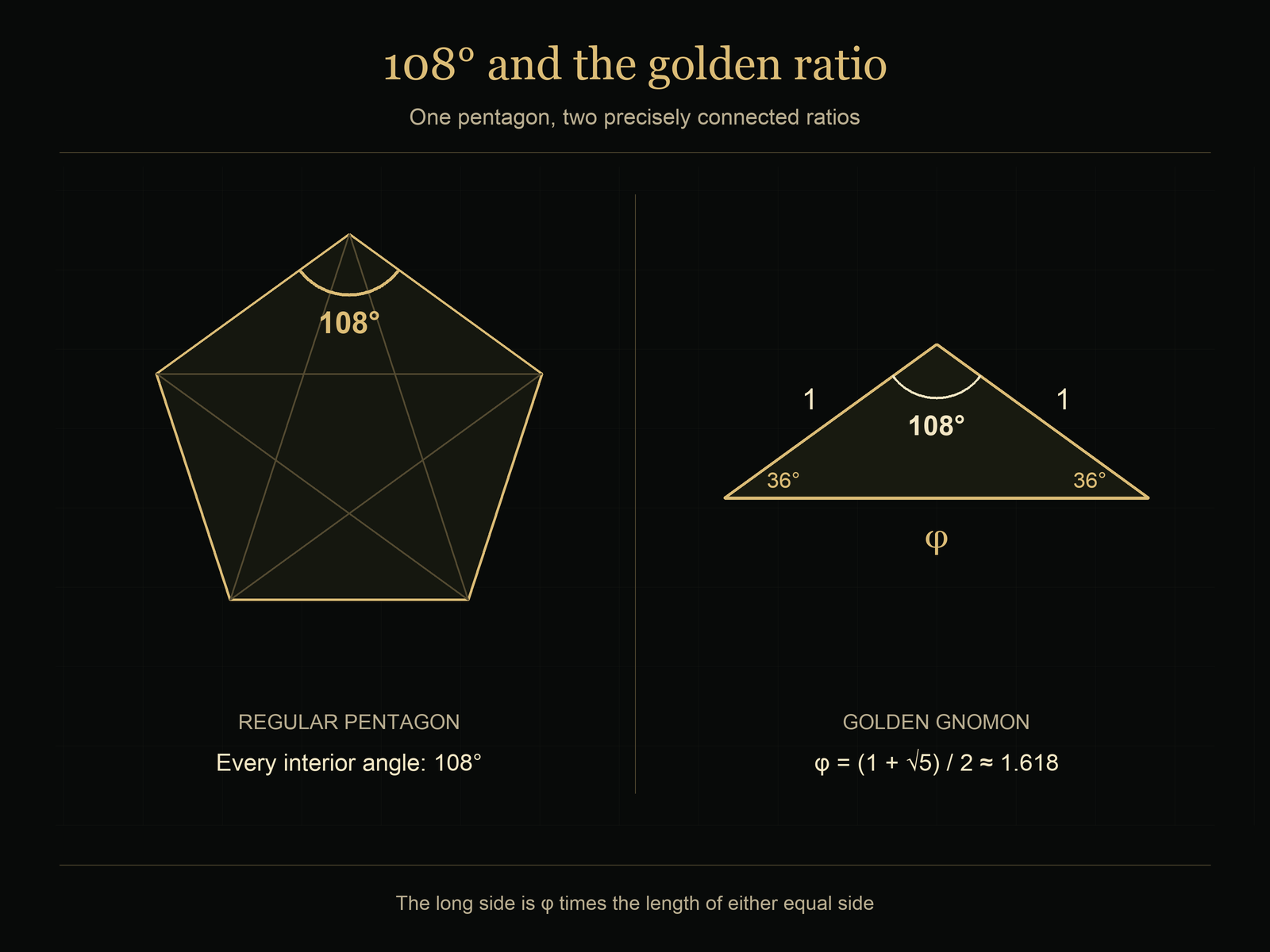
Every interior angle of a regular pentagon is 108 degrees. From that same pentagon comes the pentagram, in which line segments relate to one another through the golden ratio.
The pentagram also contains an isosceles triangle with angles of 36, 36 and 108 degrees. This golden gnomon carries the golden ratio in the relationship between its sides. Divide the figure further and smaller versions of the same golden triangles appear. The form repeats its own proportions.[^8]
Where number becomes form
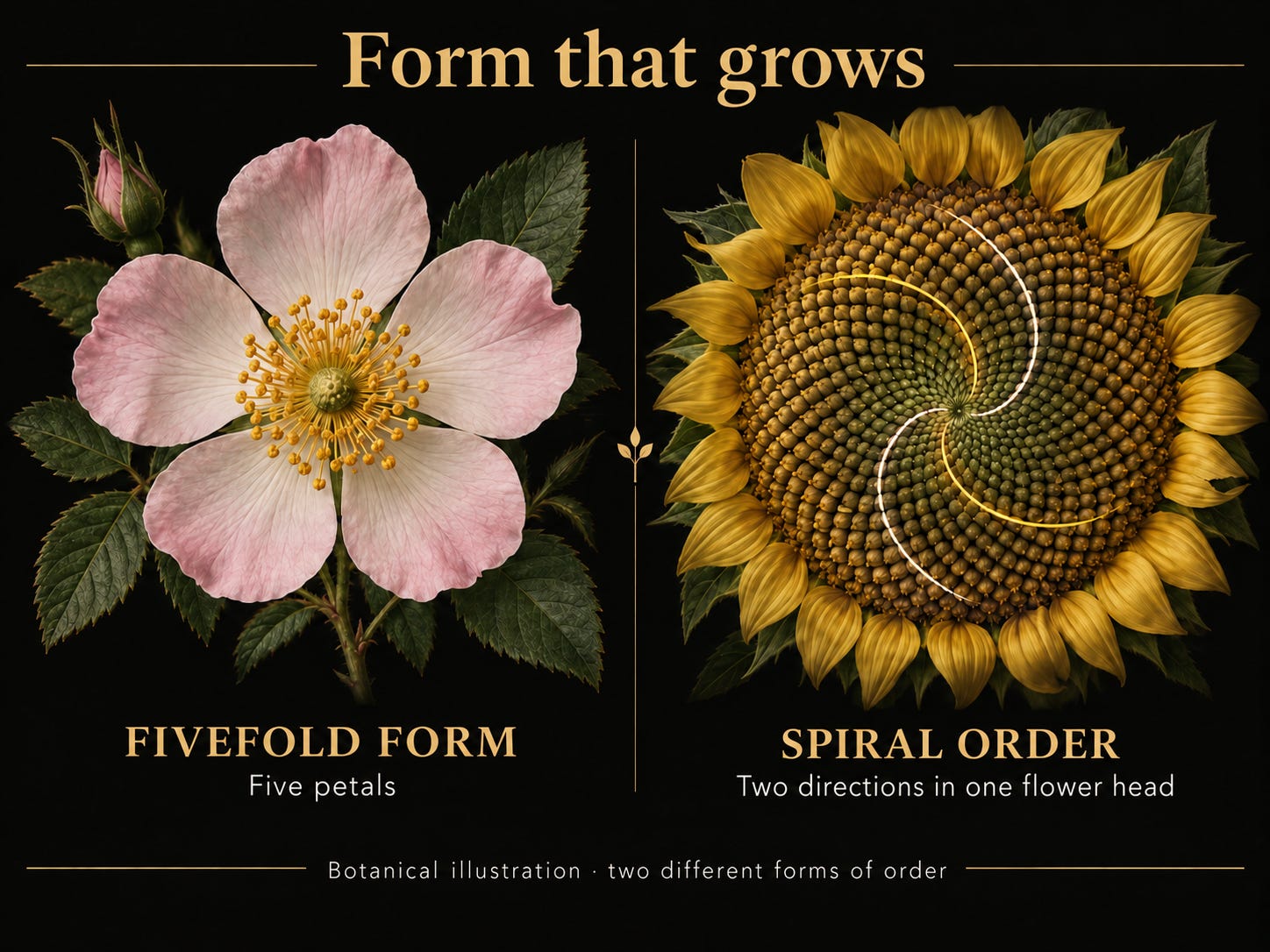
The pentagon brought us from 108 degrees to the golden ratio. In nature, we encounter both motifs again: fivefold form and order through proportion.
Fivefold form appears in the five petals of a wild rose or apple blossom, and in the star shape of many starfish. The parts arrange themselves around a centre: five directions that together sustain a single form.
The golden ratio appears in plants through a different angle: the golden angle of about 137.5 degrees. It emerges when you divide a full circle according to the golden ratio. In sunflowers, pine cones and other plants, new leaves, scales or florets are often placed at roughly that angle. This produces spiral patterns whose counts are often consecutive Fibonacci numbers.
The proportion we found between the lines of a pentagon reappears here in the ordering of growth.[^9]
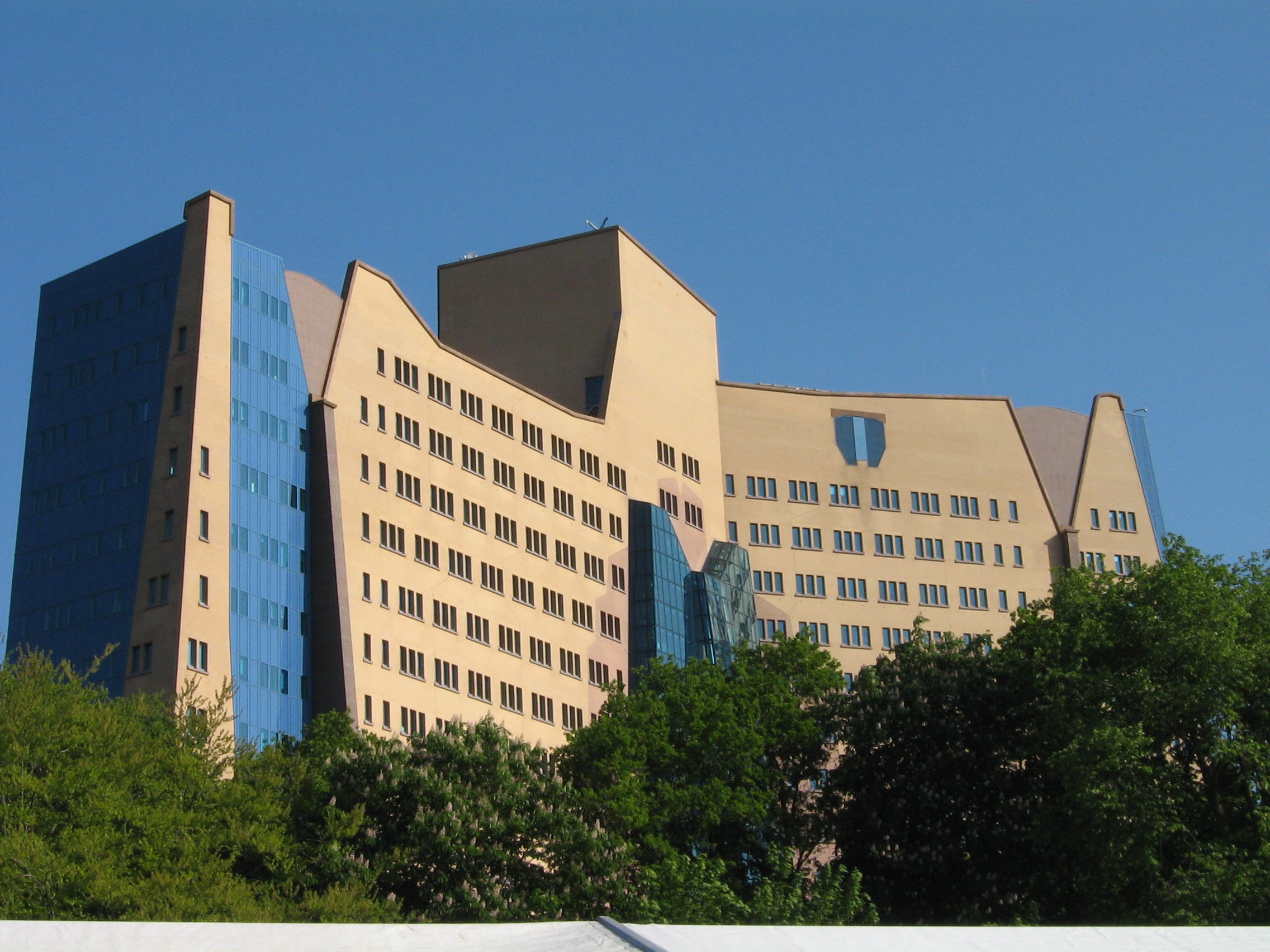
People have carried those proportions into buildings, too. Gasunie’s headquarters in Groningen (the most beautiful building I have ever had the pleasure of seeing from the inside) was designed by Alberts and Van Huut as organic architecture, with forms and materials drawn from nature. The golden ratio was used extensively in the design, and the two seventeen-storey wings meet at an angle of exactly 108 degrees, derived from the pentagon.[^10] A proportion that grows in a flower became a space where people can work.
So the relationship between 108, the pentagon and the golden ratio is no fantasy. The maths works, the corresponding forms are alive, and sometimes we build with them ourselves.
The human hand
Closer to home, we also recognise numbers from the Fibonacci sequence. A single human hand has two bones in the thumb, three in each other finger, five digits and eight carpal bones. You encounter the sequence not only in the spirals of a sunflower, but also in the counts of your own hand.
Where proportion becomes audible
Proportion can also be heard. Musical intervals arise from ratios between frequencies, and rhythm from ratios between durations. In the Pythagorean tradition, the octave, fifth and fourth were associated with the simple ratios 2:1, 3:2 and 4:3. Harmony was not merely something pleasant to the ear, but a clue to the order of the cosmos. Within that same tradition, the pentagram, in which the golden ratio repeats itself, served as a sign of recognition and was called ‘Health’.[^11]
Tool made that idea literally audible on Lateralus. In the title track, parts of a bass riff move through 9, 8 and 7 beats, read together as: 987, a number in the Fibonacci sequence. When the band recognised that connection, Maynard James Keenan also had parts of the vocals grow and recede through the sequence in their syllable counts. The best detail is that the music came first. The numerical connection was discovered afterwards.[^12]
The conditions that allow us to exist
The number can point to the actual cosmic proportions within which life arose. Without the specific relationships that actually exist, life as we know it would not exist either.
Our distance from the Sun determines how much energy Earth receives. Earth is, on average, about 149,597,870,700 metres from the Sun. Almost 150 billion metres, and yet, on a clear day, all you have to do is turn your face upwards to feel it on your skin.[^13] An Earth much closer would be warmer; an Earth much farther away would be colder. Climate, atmosphere, oceans and geological feedbacks would shift with it. And the habitable window is not very wide. Far enough beyond the present relationship, human habitability disappears first, and eventually so does the world in which complex terrestrial life could arise.
The Moon also plays an indispensable role. It causes most of our tides, has changed Earth’s rotational history and helps keep the tilt of Earth’s axis relatively stable over long timescales.[^14] Without the Moon, large swings in Earth’s axial tilt would occur, bringing more extreme shifts in climate.
Even a small change in the Moon’s distance makes a real difference. Tidal force increases much more rapidly than ordinary gravity, scaling approximately with the inverse cube of the distance. If the Moon were ten per cent closer, its tidal force would be about 37 per cent greater. More than enough to profoundly change coastlines, tidal zones, currents and the organisms that depend on them. Ten per cent farther away would weaken lunar tides by about a quarter.[^15]
Various marine animals use moonlight, tides and internal lunar clocks to synchronise reproduction. Corals release their reproductive cells on the same nights; marine worms and fish wait for a particular part of the lunar cycle. The Moon is part of the mechanism through which thousands of individual animals find one another at the same moment.
Before we recorded time in apps and calendars, a clock hung above us that everyone could see. Its waxing and waning showed where you were in the month, while the body itself carried rhythms moving at roughly the same pace.
The Sun emits light. The Moon produces no visible light of its own, but catches sunlight and reflects it back to us. You could therefore call it the memory of the day through the night: the same light, softened and transformed, so that we can look into it without having to turn our eyes away.
God as proportion
108 can stand for the particular way in which everything relates to everything else. The distance to the Sun. The Moon. The speed of rotation. The tilted axis. The tides. The chemistry. The evolutionary history.
As far as our thinking can reach, there could also have been nothing at all. No space, no time, no matter, no creation. Simply nothing. But instead of nothing, there is everything.
Because everything is as it is, everything has become what it now is.
That almost sounds like a sentence that says nothing, until we realise how radical it is. We do not exist first, with the world then happening to provide a backdrop. We emerged from that backdrop. The boundary between humanity and the cosmos is more porous than daily life would have us believe. The iron in our blood, the calcium in our bones, the rhythm of light and darkness, the gravity under which our skeletons grew and the Moon that moved the seas: these are not stage props surrounding life. They are woven into the history of what we are.
And inside us, something stranger still takes place. Matter becomes not only alive, but conscious. Consciousness is not a thing we can set on a table beside a rib, a nerve or an atom. It is the place where experience arrives. Where matter and consciousness meet, what emerges is not only life, but also the capacity to experience God. In that sense, God appears both as the relationship from which we arise and as the ungraspable reality that can be perceived within us.
Without these relationships, there might have been something somewhere that we would call life. But not this life. Not these trees, these bodies, these tidal pools, these eyes through which we watch an eclipse.
The anthropic principle rightly says that we can find ourselves only in conditions in which we could have arisen. On an uninhabitable planet, no one would be sitting around marvelling at the distance to the Sun. But that does not make the question of meaning disappear.
One hundred and eight appears in between
By now, 108 has turned out to be more than an approximation in the sky. The number opens up an entire network of relationships:
In the sky, 108 appears as the approximate ratio between distance and diameter.
In a regular pentagon, 108 appears exactly as an interior angle.
In India, 108 appears as a number that is counted, sung, danced, built and touched.
In the Gasunie building, the golden ratio and an angle of 108 degrees appear deliberately together in architecture.
The astronomical 108 is approximate. The geometrical 108 is exact. The cultural 108 is consciously chosen. These examples bring us to the same fundamental phenomenon:
Separate parts that, through their relationships with one another, bring a larger form into being.
The veil of what we take for granted
In the Bhagavad Gita, Maya is often understood as a veil: not because the world does not exist, but because we forget its interconnectedness. These days, that veil can look suspiciously like a screen. We receive thousands of images and spend less and less time considering the fact that we live on a rotating planet orbiting a star.
An eclipse breaks that habit. The familiar light changes, and suddenly we notice that we are part of something we do not control. For a moment, the messages on a phone become smaller than the Sun and Moon.
Perhaps 108 serves the same purpose within a ritual. Repeating a mantra 108 times takes long enough to change not only the words, but also the person speaking them. The beads give attention a body: as soon as the mind wanders, the next bead is already between thumb and finger.
The number does not need to be a secret access code to the universe. It only needs to be a form that keeps us here long enough to see again.
A temporary cosmic window
Even the eclipse ratio will not last.
On average, the Moon moves about 3.8 centimetres away from Earth each year. Once, it was closer and appeared larger in the sky. In about six hundred million years, it will have receded so far that it can no longer completely cover the Sun from anywhere on Earth.[^16]
So we live not only in the right place, but within a particular window of time. An intelligent being on the far-future Earth would see the same Sun and the same Moon, but would never witness one disc disappearing almost exactly into the other.
That temporary covering has itself helped us understand the Sun better. During totality, the corona becomes visible. In 1868, an unknown yellow line was observed in the spectrum of sunlight. The element behind it was given a name that refers to the Sun: helium. Only later was it found on Earth.[^17]
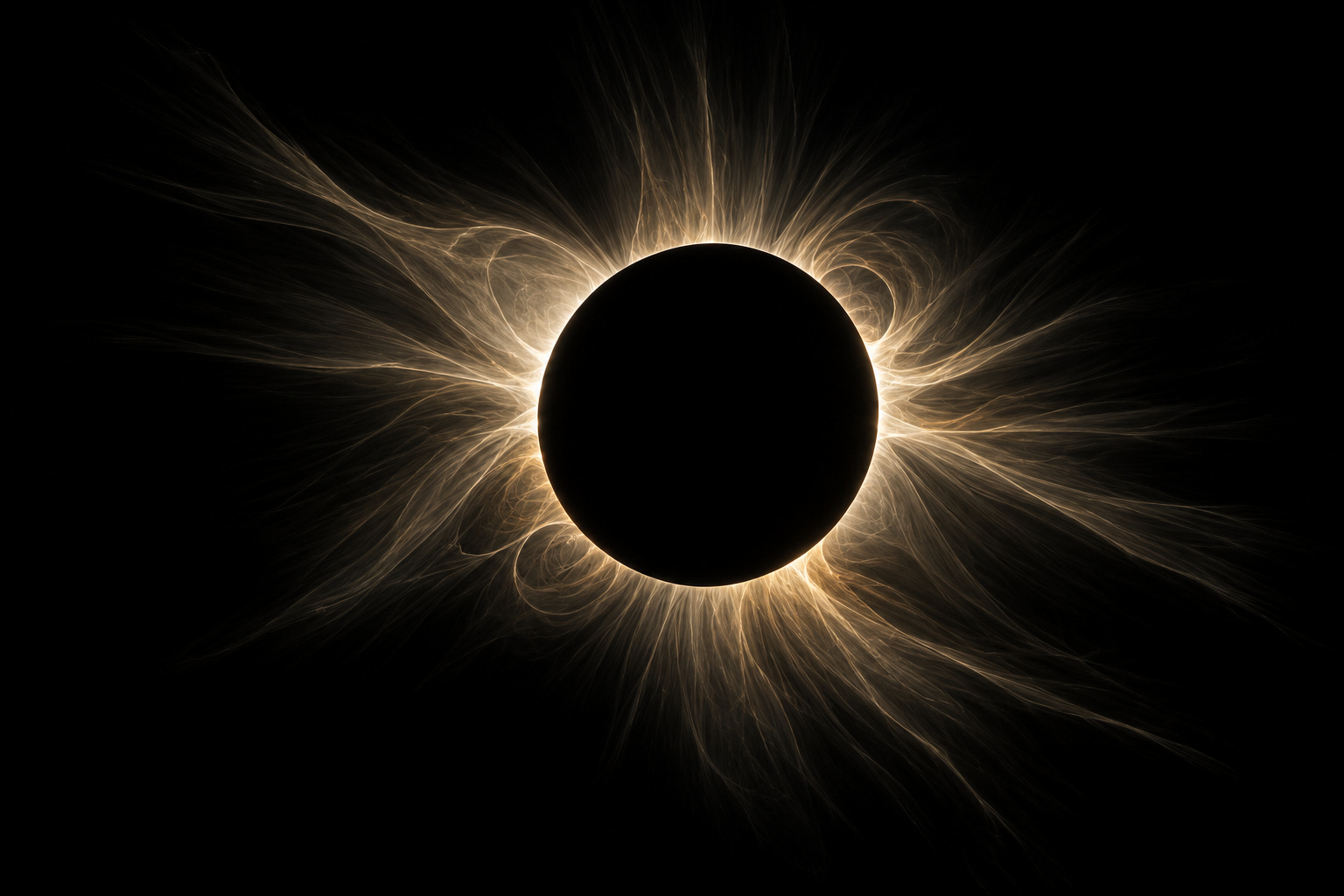
The Moon hid the light and revealed the Sun. A shift between two celestial bodies made visible what had been above us all along.
That is where the meaning of all these relationships lies: they bring something into being. The placement of notes makes a melody. The cooperation of countless processes makes a living body. What we recognise as a single thing exists through an entire interplay.
Proportions are the foundation of creation
That creative capacity is what I mean here by God. The power of design in nature itself: the capacity through which matter takes form, life emerges, and eventually eyes open. Eyes through which creation can admire its own forms. In that light, the ancient reverence for 108 takes on a profound meaning. A ratio becomes a number, a number becomes a ritual, and the ritual keeps wonder alive.
And somewhere within that immense history, there you are.
Your eyes move across these words. Your heart beats. While you read about interconnectedness, an almost inconceivable interplay keeps you alive. Everything that seemed so vast and distant in this article comes together here: in a body that breathes, perceives, thinks and can be moved by a few notes or a changing sky.
That is what makes wonder so extraordinary. The world brings forth beings who can experience how wondrous that world is. Matter acquires eyes. Proportion becomes experience. And on a small planet, someone looks up, sees the Moon move in front of the Sun, and gets goosebumps.
The eclipse arises between the Sun and the Moon.
The wonder arises between the eclipse and you.
You, too, are part of that interplay.
Sometimes the light goes out for a moment, so that we can see again.
Lux et Veritas,
The Mythicus
🔮 Continue the exploration
Want to explore these ideas further? In The Rebus Method, you’ll find a practical framework for systematically examining your thoughts, emotions and patterns.
→ Discover the E-book
Sources
Hartstone-Rose, A. et al. (2020). “Total Eclipse of the Zoo: Animal Behavior during a Total Solar Eclipse.” Animals, 10(4), 587. https://doi.org/10.3390/ani10040587
NASA. “Sun: Facts.” https://science.nasa.gov/sun/facts/
NASA. “Eclipses Near and Far.” https://www.nasa.gov/history/eclipses-near-and-far/
Kak, S. (2005). “The Axis and the Perimeter of the Temple.” https://arxiv.org/abs/0902.4850
Vatsyayan, K. (1968). Classical Indian Dance in Literature and the Arts. Sangeet Natak Akademi. On the problems of reconstruction, see also: Lopez y Royo, A. (2004). “Issues in Dance Reconstruction: Karaṇas as Dance Texts in a Cross-Cultural Context.” Dance Research Journal, 36(2), 64–79. https://doi.org/10.2307/20444592
Morris, R. D. “Tala, an Overview of Rhythmic Structures in Indian Music.” Eastman School of Music. https://ecmc.rochester.edu/rdm/pdflib/talapaper.pdf
Christensen, T. M. (2021). “Luke and the Nature of the Twelve New Tribes.” European Journal of Theology, 30(2), 275–299. https://doi.org/10.5117/EJT2021.2.003.CHRI; see also Matthew 19:28 and Luke 22:30.
Weisstein, E. W. “Golden Gnomon.” Wolfram MathWorld. https://mathworld.wolfram.com/GoldenGnomon.html
Swinton, J. et al. (2016). “Novel Fibonacci and non-Fibonacci structure in the sunflower: results of a citizen science experiment.” Royal Society Open Science, 3, 160091. https://doi.org/10.1098/rsos.160091
Toegankelijk Groningen. “Gasunie.” https://www.toegankelijkgroningen.nl/locaties-overzicht/1780137195/gasunie; Architectuur.ORG. “Hoofdkantoor Gasunie.” https://www.architectuur.org/bouwwerk/46/Hoofdkantoor_Gasunie.html
“History of Western Philosophy of Music: Antiquity to 1800.” Stanford Encyclopedia of Philosophy, §§ 1.1–1.2. https://plato.stanford.edu/entries/hist-westphilmusic-to-1800/; Lucian. “A Slip of the Tongue in Salutation.” In The Works of Lucian of Samosata, trans. H. W. Fowler & F. G. Fowler (1905). https://archive.sacred-texts.com/cla/luc/wl2/wl204.htm
Reed, R. (2022). “‘The Curse of TOOL’: Adam Jones Looks Back on Pivotal Album Lateralus.” Revolver. https://www.revolvermag.com/music/curse-tool-adam-jones-looks-back-pivotal-album-lateralus/
NASA Jet Propulsion Laboratory. “Astronomical Unit (au).” https://ssd.jpl.nasa.gov/glossary/au.html
Laskar, J., Joutel, F. & Robutel, P. (1993). “Stabilization of the Earth’s obliquity by the Moon.” Nature, 361, 615–617. https://doi.org/10.1038/361615a0. For a later qualification, see: Li, G. & Batygin, K. (2014). “On the spin-axis dynamics of a moonless Earth.” The Astrophysical Journal, 790(1), 69. https://doi.org/10.1088/0004-637X/790/1/69
NOAA National Ocean Service. “What Causes Tides?” https://oceanservice.noaa.gov/education/tutorial_tides/tides02_cause.html
NASA. “The Moon Is Front and Center During a Total Solar Eclipse.” https://www.nasa.gov/missions/the-moon-is-front-and-center-during-a-total-solar-eclipse/
NASA. “Spots, Waves and Wind: A Solar Science Timeline.” https://www.nasa.gov/history/spots-waves-and-wind-a-solar-science-timeline-full-text/