


Chakras as symbolic language
Chakras. You have probably heard of them before. But what are they, exactly? Are they simply a vague spiritual concept, or is there more to them? Why do chakras play such an important role in certain Indian yogic and tantric traditions? And can it be useful to know something about them?
Those were some of the questions I once had about chakras. When you start looking for information, you quickly find an enormous body of material. Thousands of books have been written on the subject, each approaching it from a different angle. Many articles are incomplete as well.
That is why I have brought together the key information within this approach in one, hopefully understandable, account. It is still a fairly extensive article, there is no real way around that, but I think it can be valuable to know something about the subject. At the very least, you now have one place where you can find a concrete explanation of what chakras are and what they may offer you.
What are chakras?
Chakras originate in several Indian religious and spiritual traditions. Their number, location and meaning vary from one tradition to another. In this article, we use the now-familiar model of seven chakras as a symbolic map for themes such as safety, connection, self-expression, insight and meaning. The psychological interpretation below is a modern reading, not one fixed original system.
You do not have to regard chakras as literal entities in order to find this model useful. As an inner map, they can help you recognise patterns: where do you feel tension, where do you make yourself smaller, and where is connection or direction lacking? They give language to experiences that can be difficult to place, and can offer an entry point for self-inquiry, meditation and personal development.
Let us first look at the places in or around the body that the seven chakras are symbolically associated with in this approach.
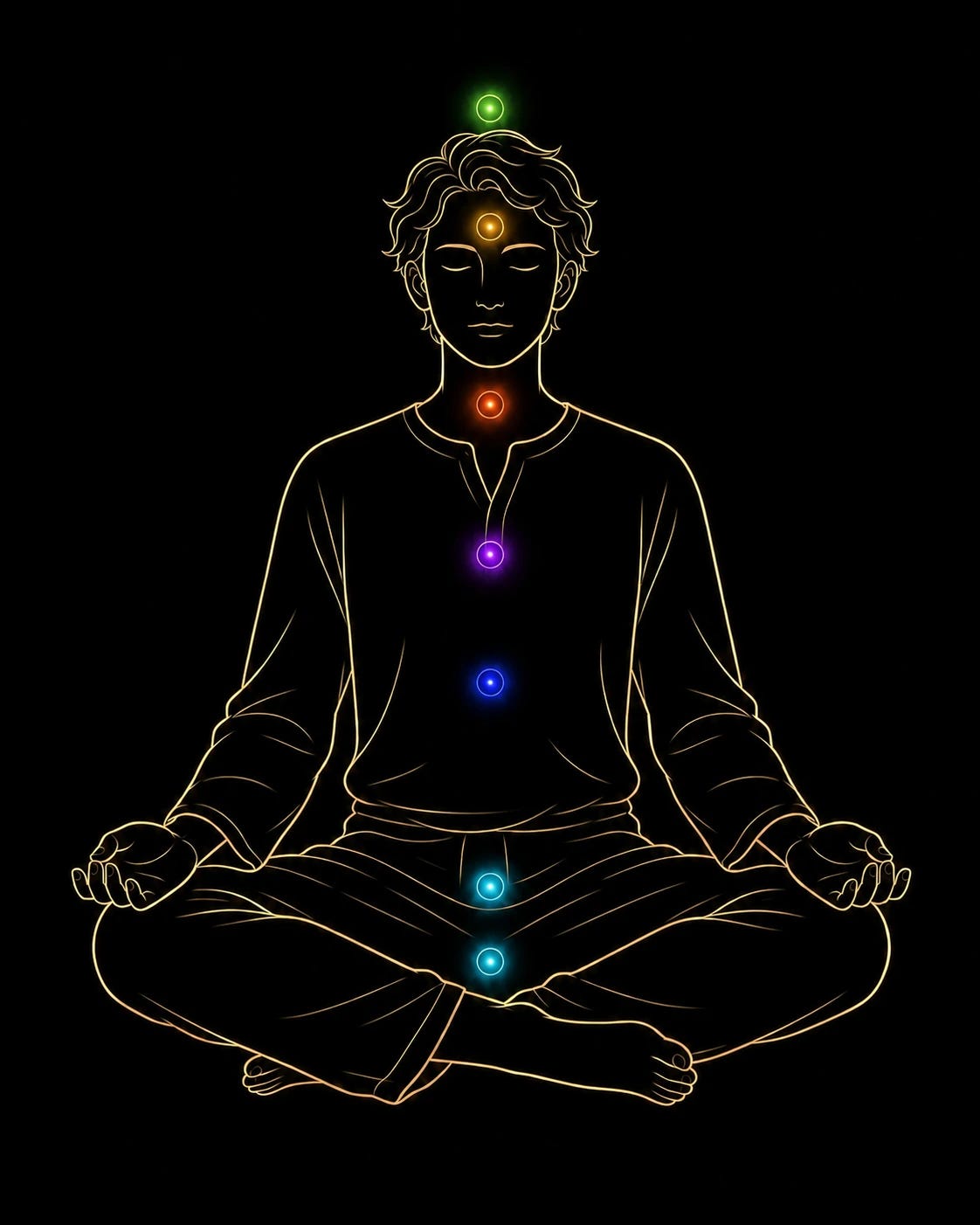
Take a moment to look through the chart below. What do you notice in yourself? Which theme currently seems to have too little room, or to demand a great deal of attention?
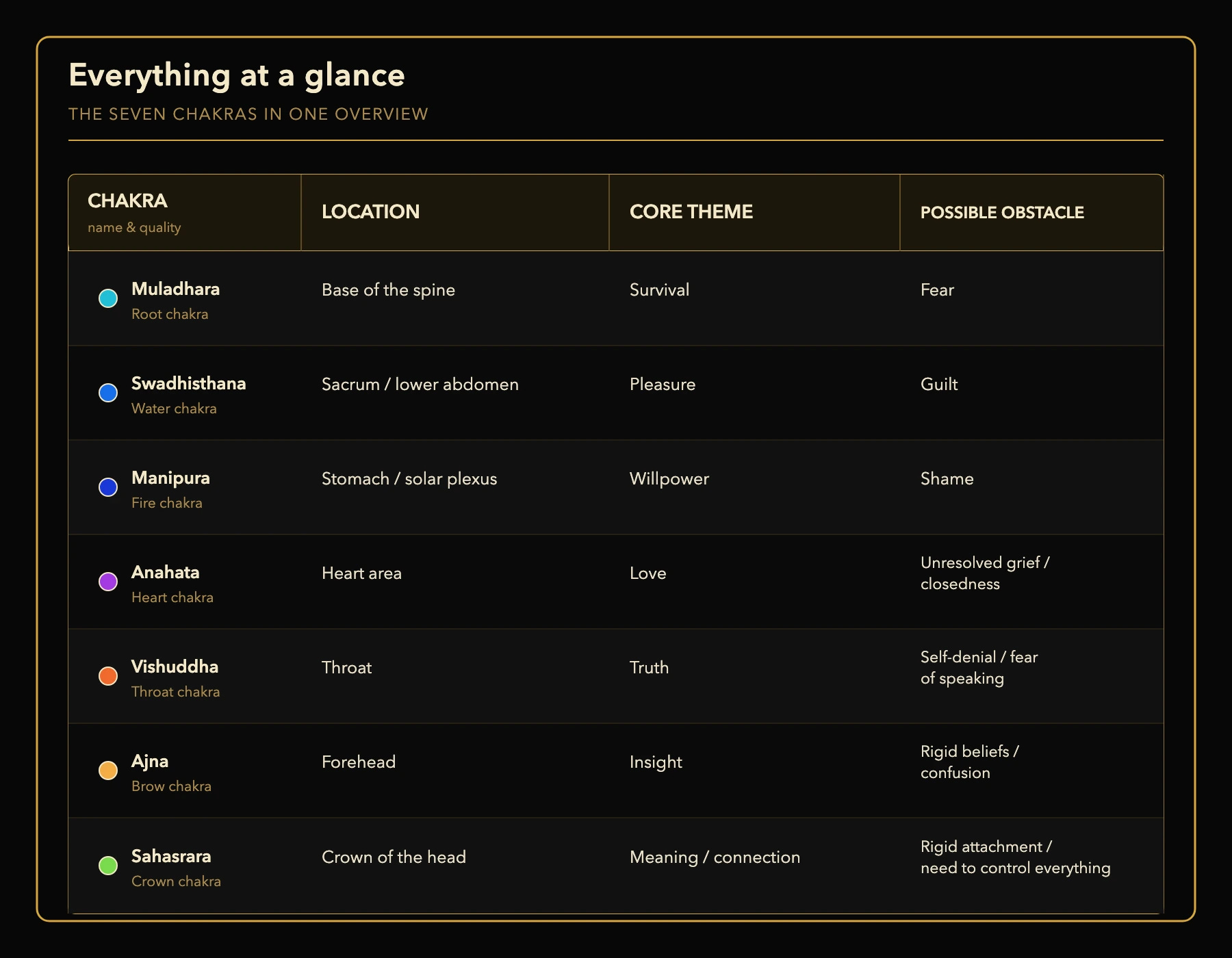
In this article, we use the chakras as a spiritual and philosophical map of human experience. They are not a medical diagnosis or a fixed truth about the body, but a language for exploring what is alive in you: safety, desire, will, love, expression, insight and surrender.
Each chakra is described using the same structure, presented visually to keep the information as clear as possible. After all seven chakras, you will find a final summary visual.
Location - the symbolic place in or around the body.
Element - the quality associated with the chakra.
Right- what you may allow yourself.
Focus - what the chakra draws your attention to.
Development - what you can practise in this area.
Sensory gateway - a practical way to experience the quality.
What opens / obstructs - attitudes that make more room for the energy, or narrow it.
In balance / out of balance - points of recognition, not a diagnosis.
Practice - a small, concrete invitation.
1. Muladhara - Root chakra
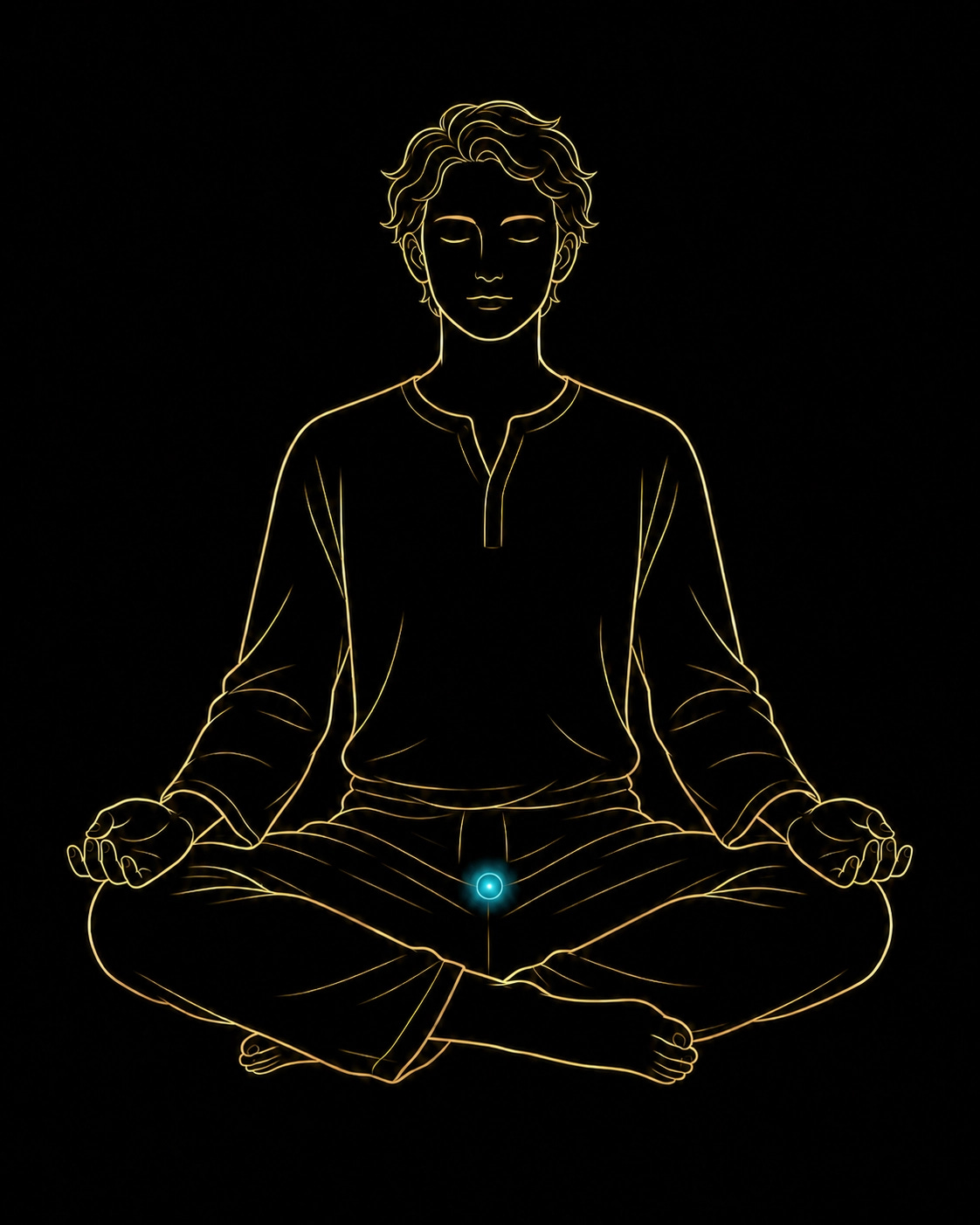
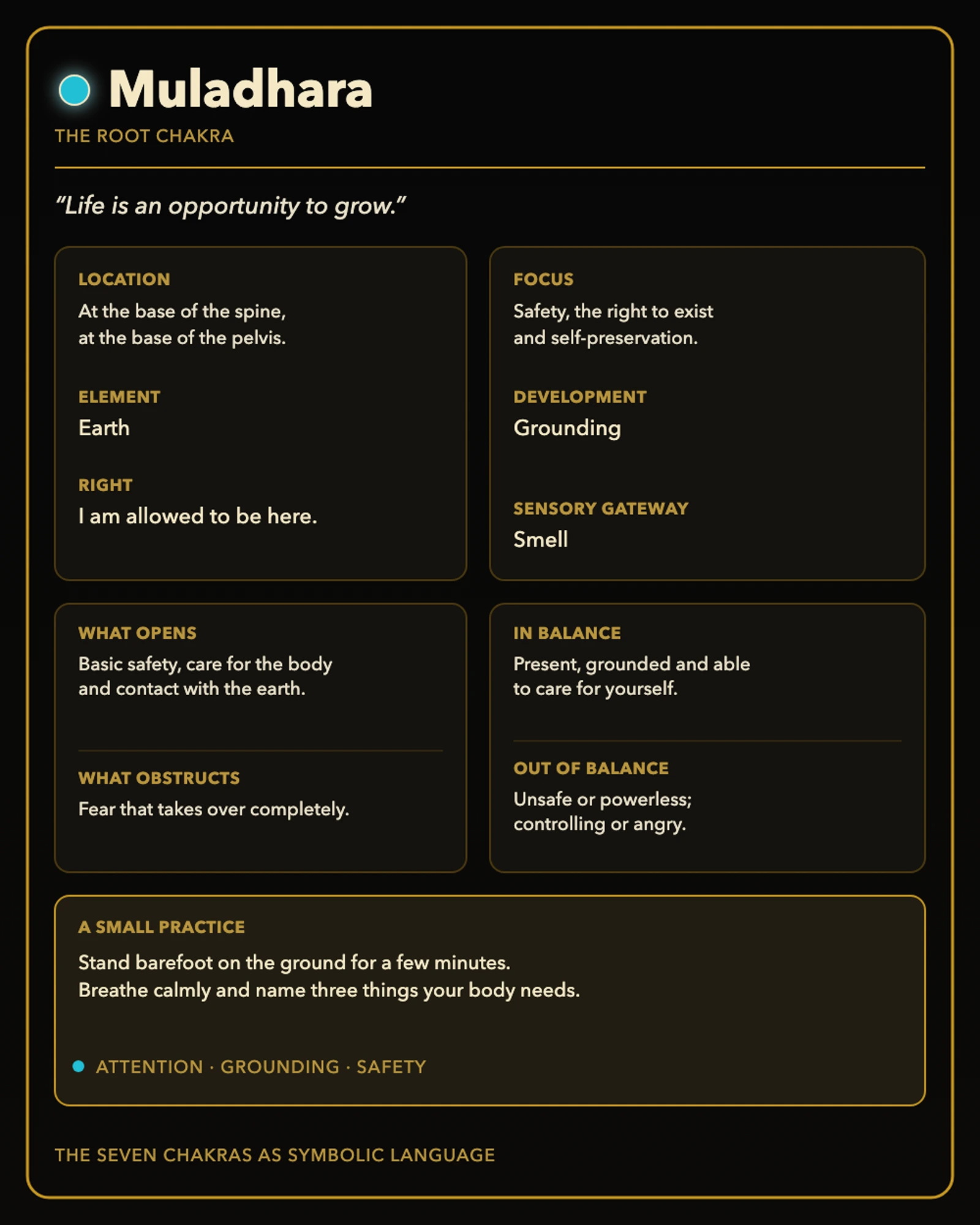
Muladhara forms the foundation of this map and concerns safety, the right to exist and contact with your body. The central question is simple: do I feel that I am allowed to be here? When that foundation feels unstable, fear can take up a great deal of space. You may then look for safety mainly outside yourself: in control, possessions, approval or the opinions of others.
Grounding does not mean that you are never afraid. It means that fear does not have to determine everything. It helps to look concretely at what you need: rest, food, movement, clear boundaries, or someone with whom you feel safe. These are not minor things; they are ways of reconnecting with yourself.
Your body is not an obstacle, but the place from which you live. As you learn to listen more closely to physical signals, it becomes easier to make your sense of safety less dependent on the outside world. Standing barefoot on the ground can be a simple beginning, but above all: discover what you need in order to feel present and supported.
Fear may be present, but it does not have to determine how you live.
2. Swadhisthana - Water chakra
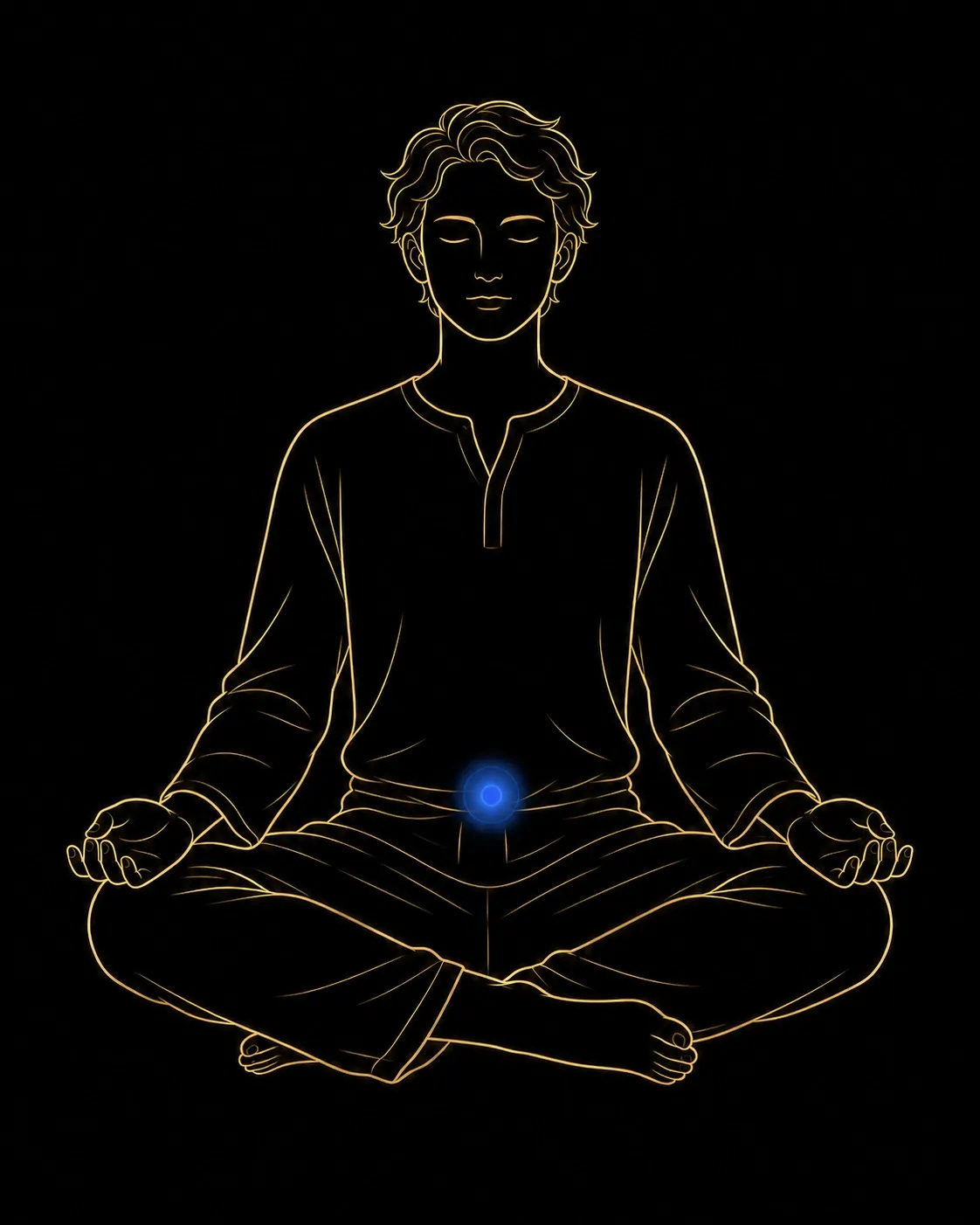
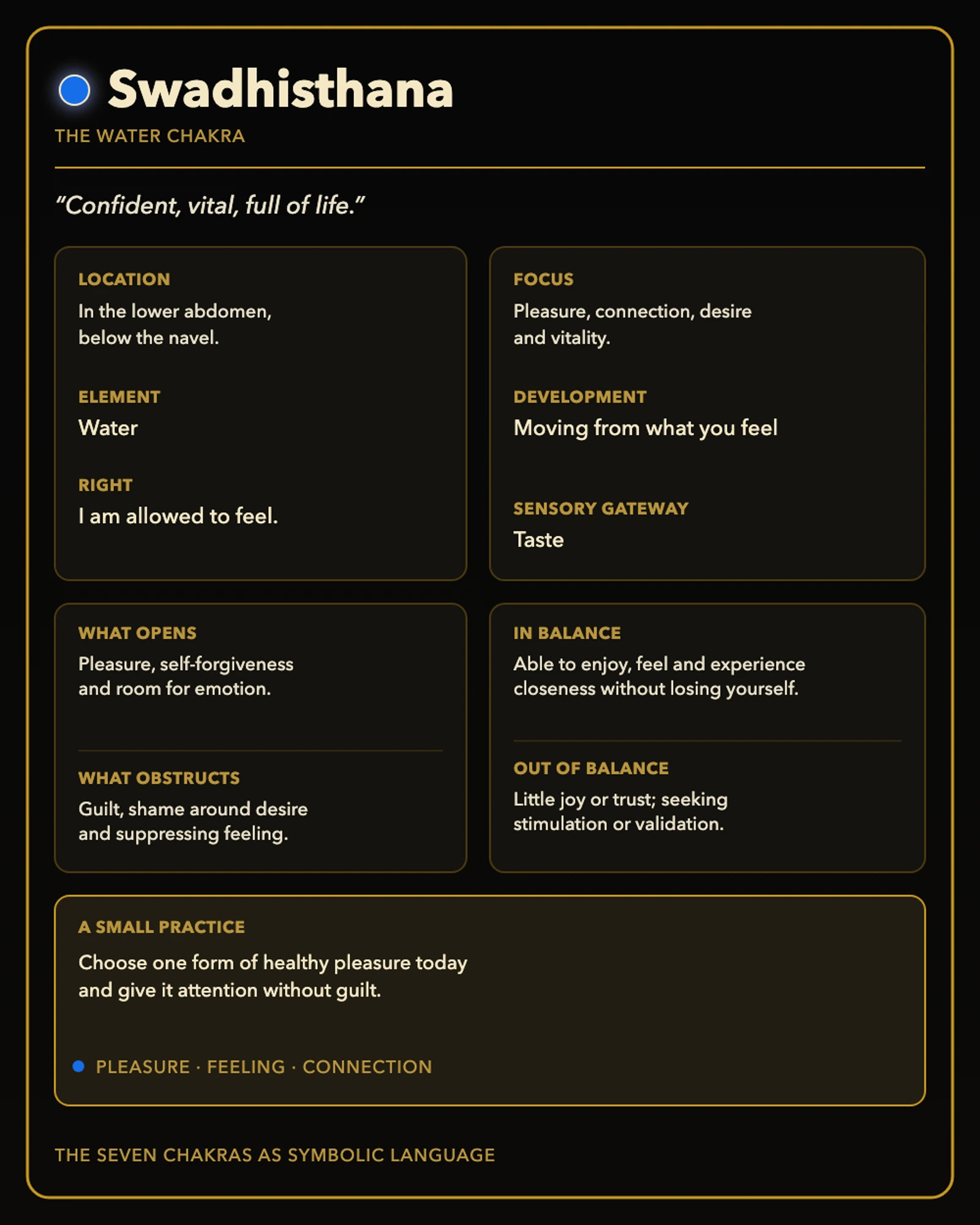
Swadhisthana concerns feeling, pleasure and vitality. It relates to your body, emotions, desire and the room to enjoy life. The question is: can I feel what is moving within me without immediately suppressing or judging it?
This also involves balance: between enjoyment and boundaries, rest and movement, letting go and taking good care of yourself. When that balance is absent, you may feel empty, restless or constantly in search of stimulation.
Guilt often keeps you tied to the past. Self-forgiveness does not mean pretending that nothing happened. It means looking honestly at what you blame yourself for, learning from it, and not punishing yourself endlessly. When you take emotions and desires seriously without being completely swept away by them, there is more room for pleasure, creativity and trust.
Enjoyment begins where you stop punishing yourself for what you feel.
3. Manipura - Fire chakra
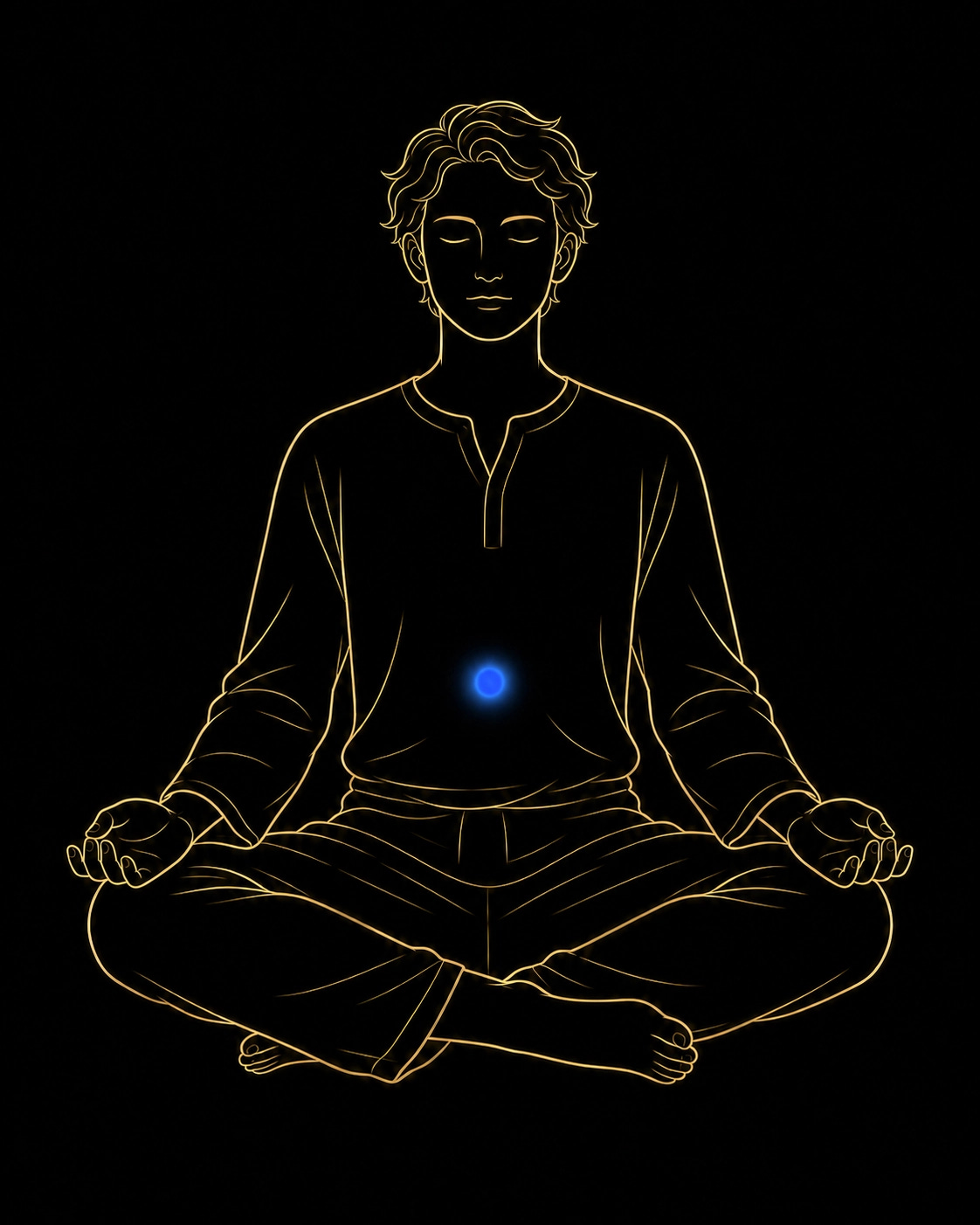
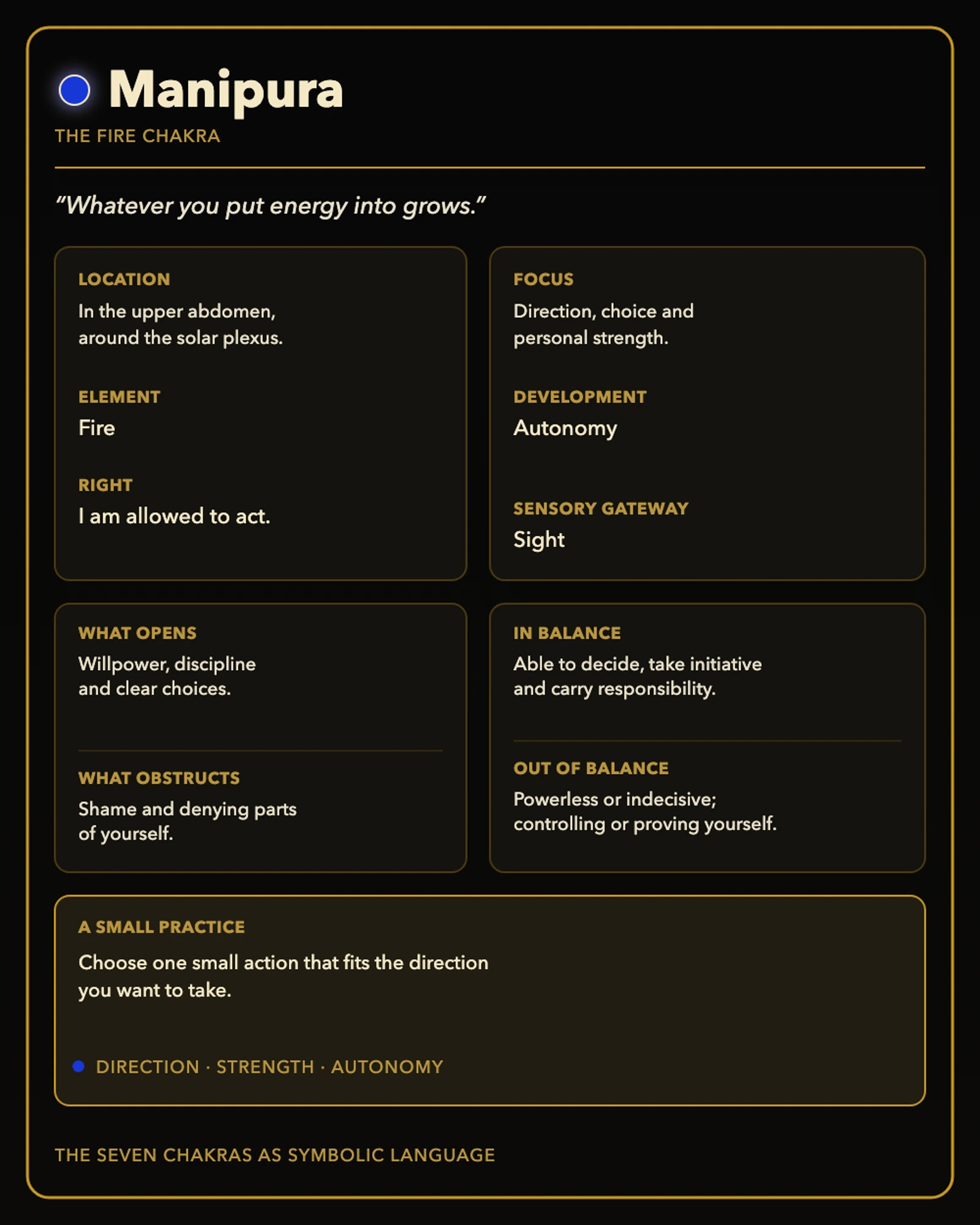
Manipura concerns giving direction to your life. What you feel inside; your wishes, ideas and desires, takes shape here in choices and action. The question is: do I dare to choose and take responsibility for what I want?
Personal strength does not mean that you must always be certain, have everything under control or never make mistakes. It is the willingness to act, even when something still feels exciting or uncertain. Shame can get in the way. If you reject parts of yourself, it becomes harder to move freely and make choices.
Your identity is not fixed. You change through experiences, relationships and the choices you make. Manipura invites you not to remain stuck in who you used to be, or thought you had to be, but to explore who you want to be now. Giving this side of yourself too little room can leave you feeling powerless or indecisive; too much emphasis can turn into dominance or control.
Strength does not begin with certainty, but with a choice you dare to make.
4. Anahata - Air chakra
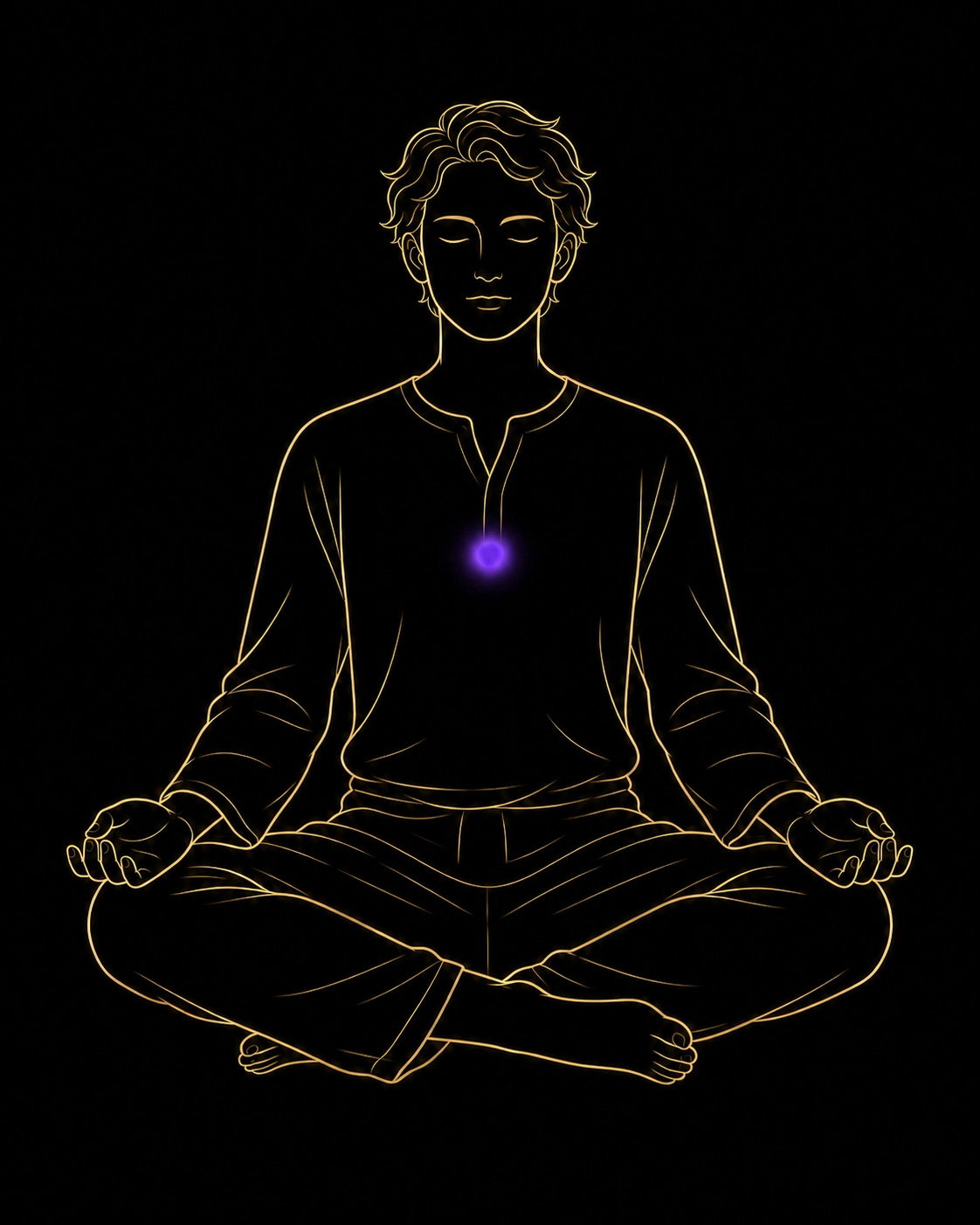
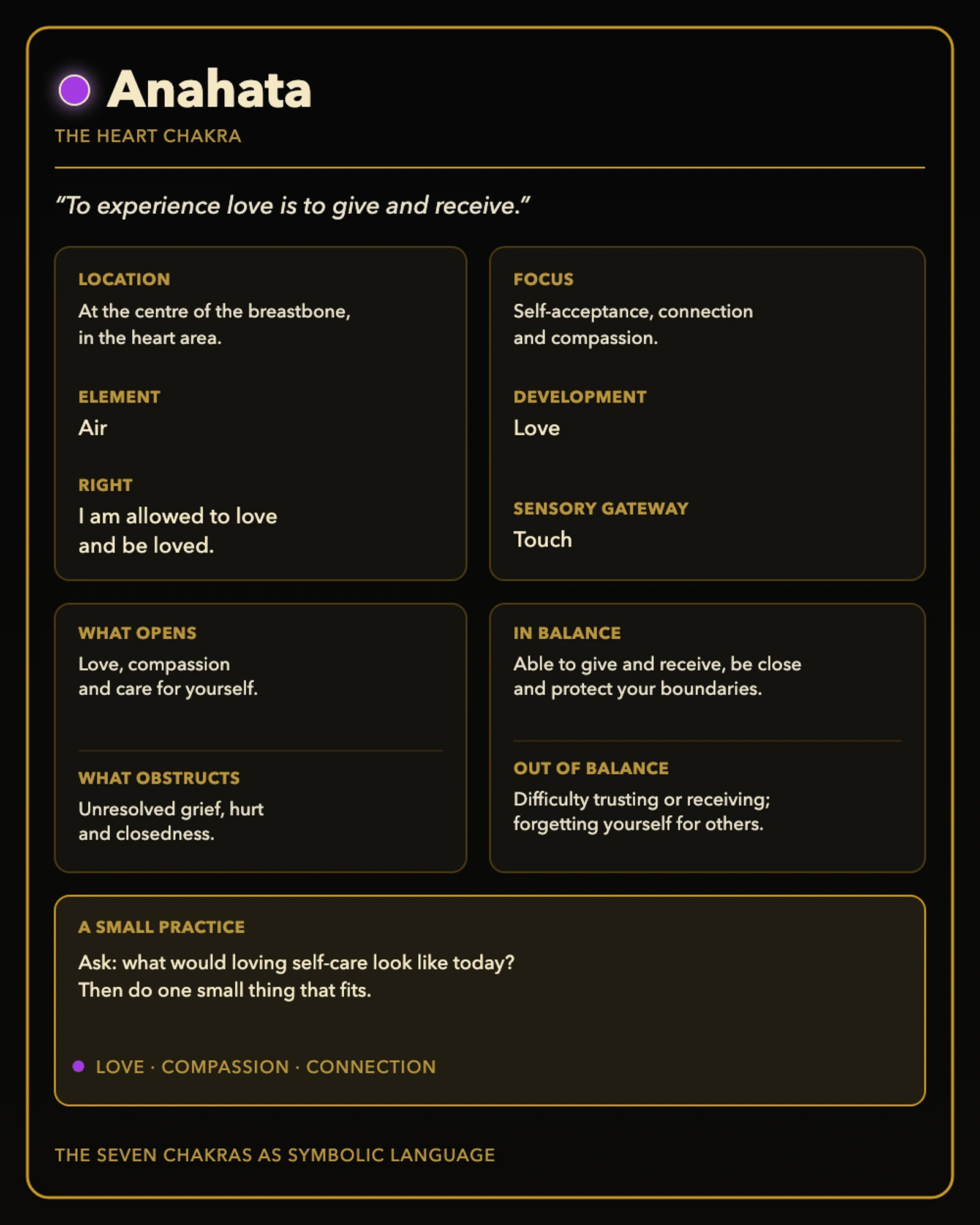
Anahata concerns love, connection and self-acceptance. The question is: can I open myself without losing myself? Love is not only about what you feel for others, but also about how you treat yourself when you are sad, vulnerable or uncertain.
Grief can cause you to close yourself off. Yet grief does not first have to disappear before connection can have room again. It helps to take loss and hurt seriously rather than suppressing them. Compassion often begins by acknowledging that something hurts.
An open heart also means that receiving is as important as giving. If you are always caring for others, you may forget yourself. If you only wait for love from outside yourself, you may become dependent on it. Balance develops when you can be close to others while also taking your own boundaries, needs and care seriously.
Love does not ask you to forget yourself.
5. Vishuddha - Throat chakra
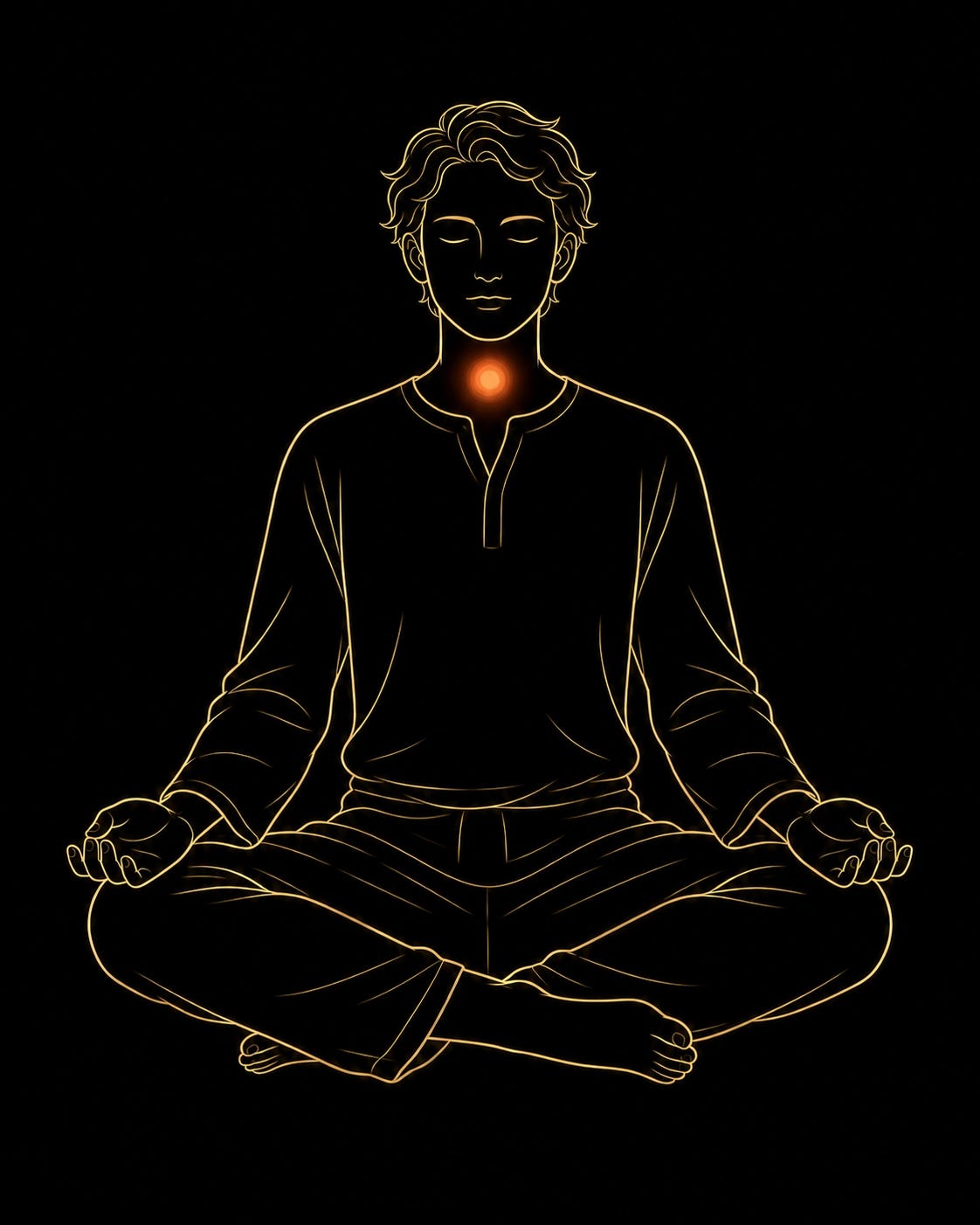
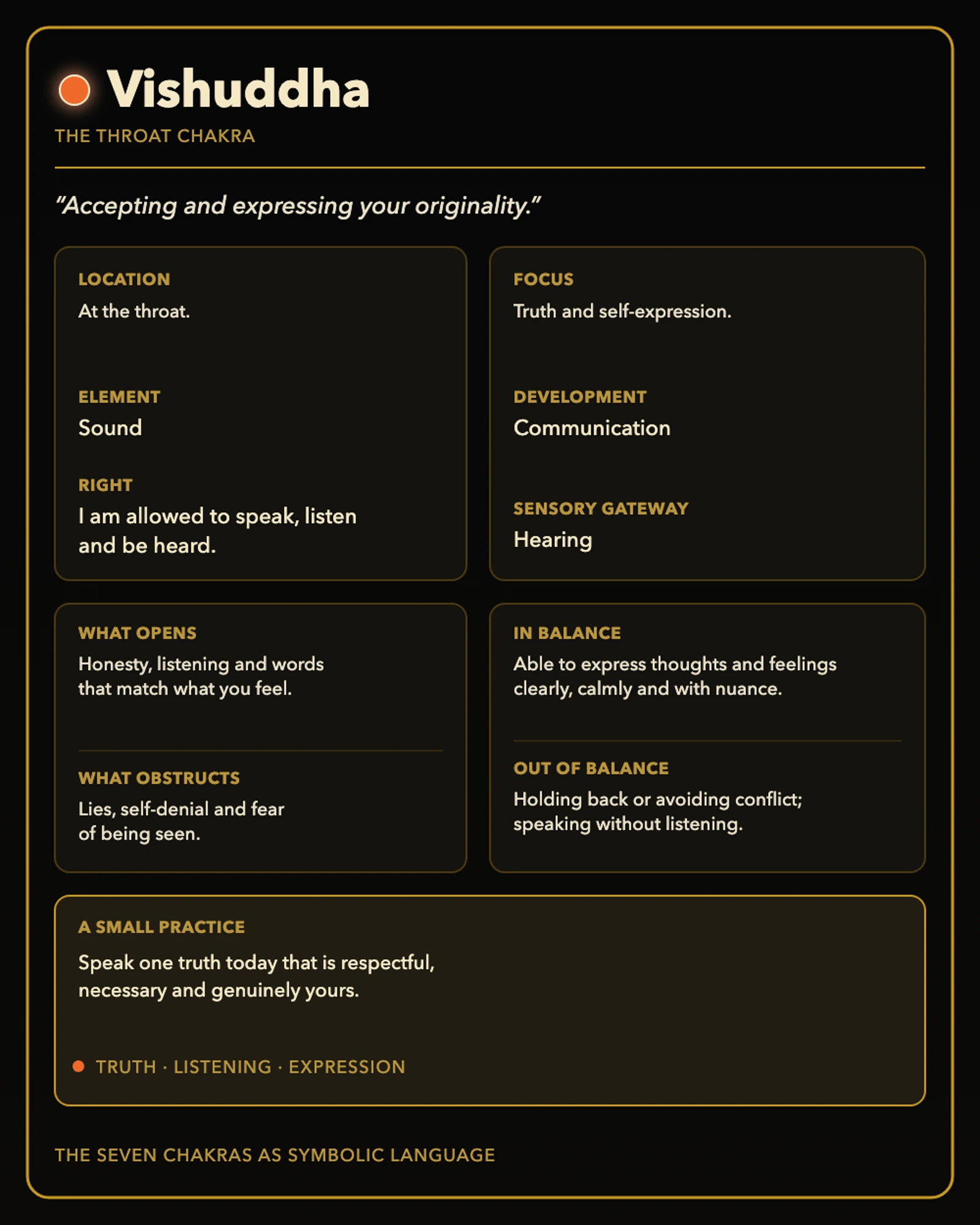
Vishuddha concerns speaking, listening and expressing yourself honestly. This chakra connects your inner world to the outer world: what do you feel, what do you think, and how do you put it into words? The question is: do I dare to make clear what is really going on within me?
Honest communication does not mean that every thought has to be spoken immediately. It means learning to name what you feel, need and find important without making yourself smaller, but also without overwhelming someone else. Listening is just as important as speaking.
Sometimes you hold things back because you fear conflict, rejection or being seen. At other times, you say a great deal without truly making contact. Vishuddha invites you to explore both sides. The more closely your words match what you actually feel, the clearer and calmer communication can become.
Speaking honestly begins with listening to what is really alive within you.
6. Ajna - Brow chakra
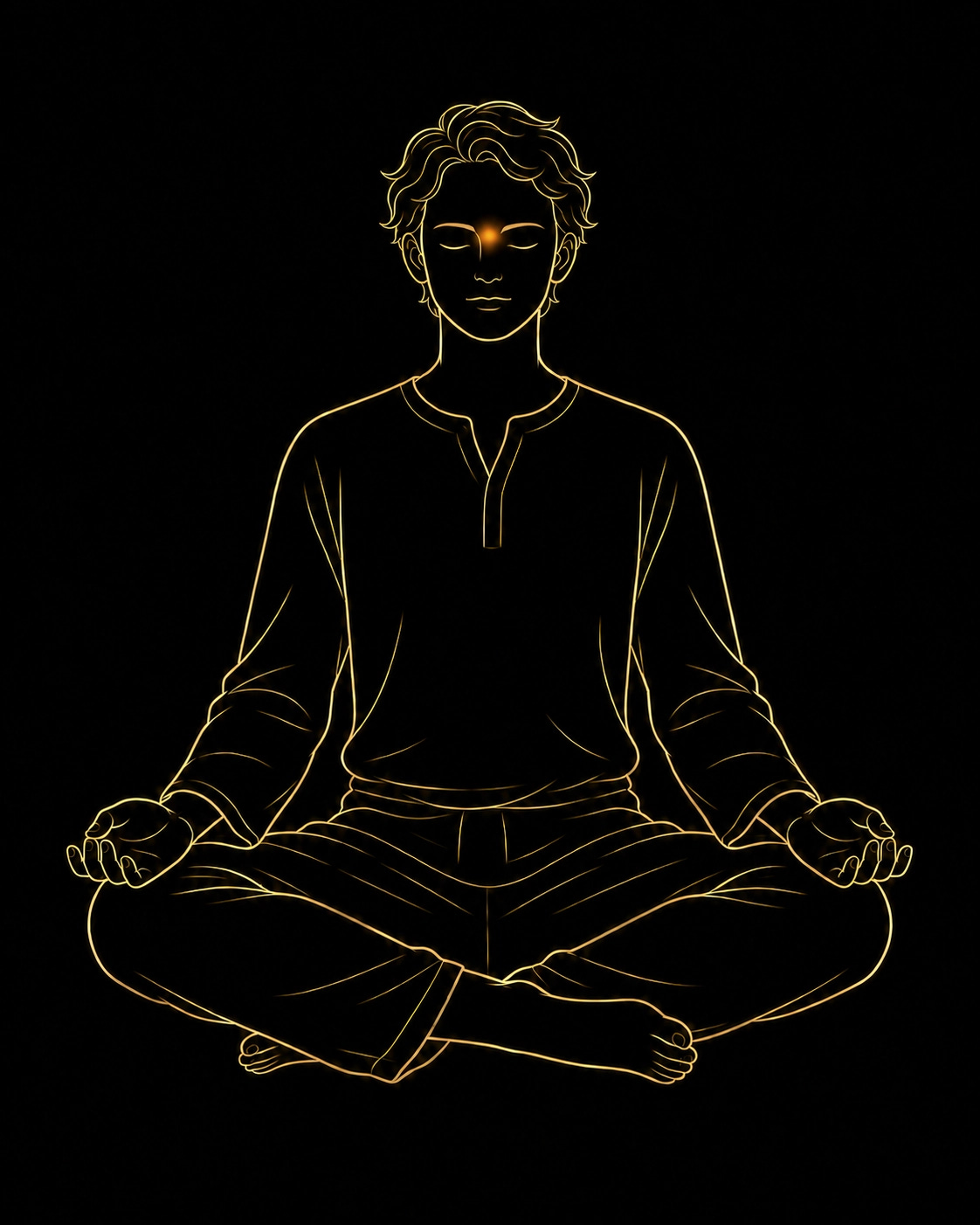
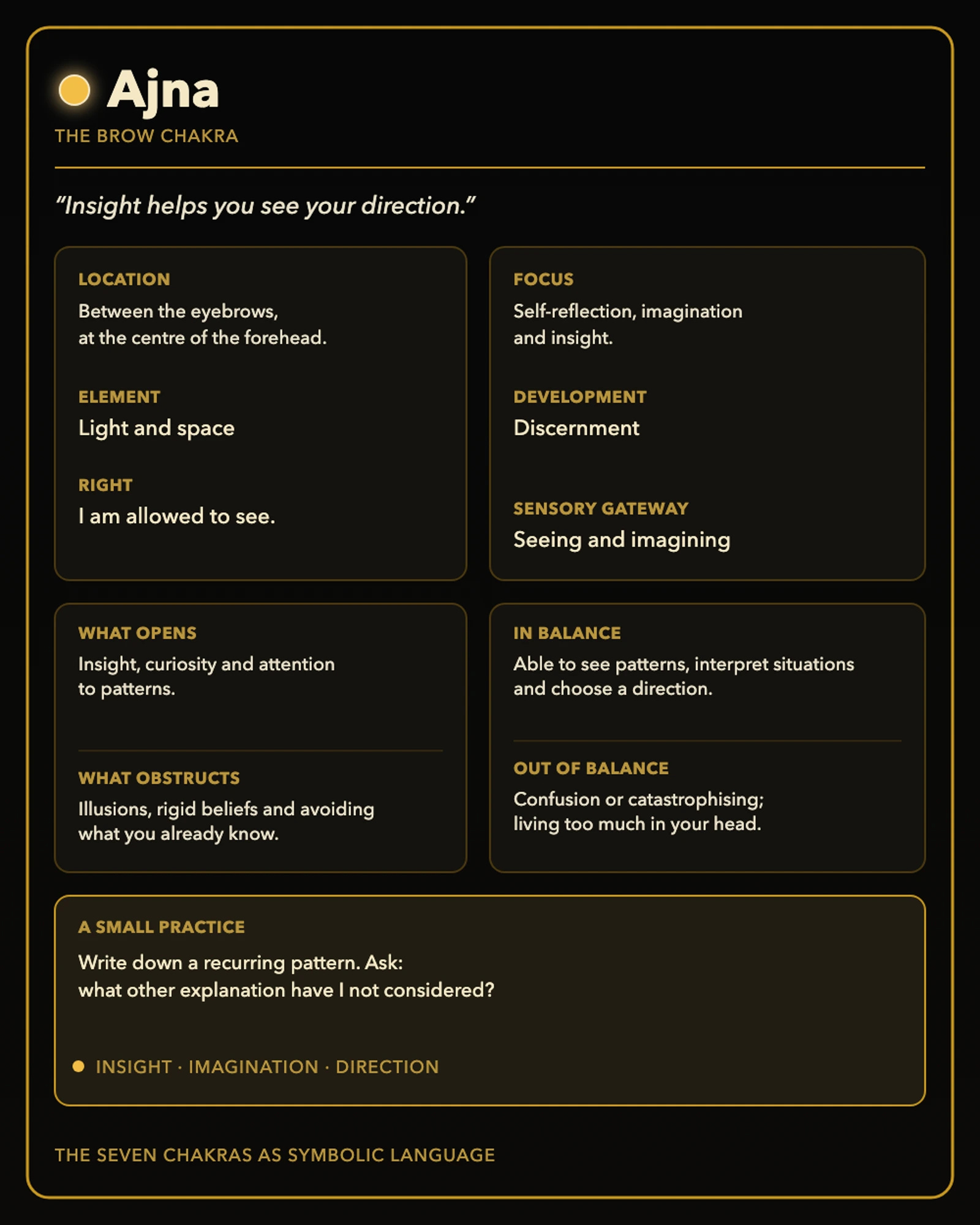
Ajna, also called the third eye, concerns insight, self-reflection and imagination. The question is: can I look beyond my first interpretation? We never see the world entirely neutrally. Memories, expectations and fears shape how we understand situations.
Insight does not mean having all the answers. It means being willing to notice patterns, examine assumptions and make room for another explanation. Sometimes a story you tell about yourself or someone else turns out to be less fixed than you thought.
Imagination can help with this. Not to escape reality, but to see possibilities that do not yet exist. When you understand recurring patterns more clearly, you can choose your direction more consciously. Without that insight, you may remain caught in confusion, assumptions or catastrophic thinking.
Insight emerges when you make room for another perspective.
7. Sahasrara - Crown chakra
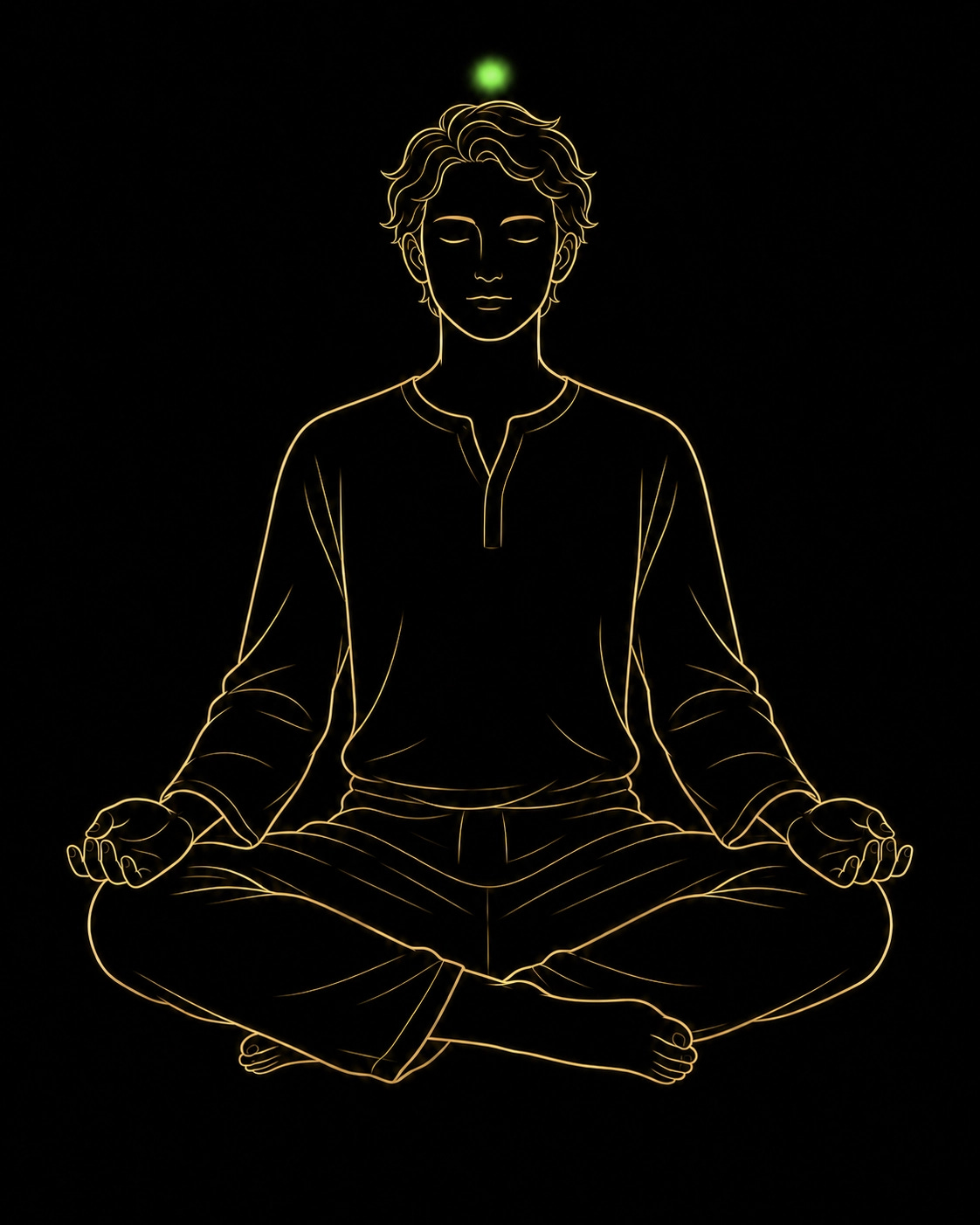
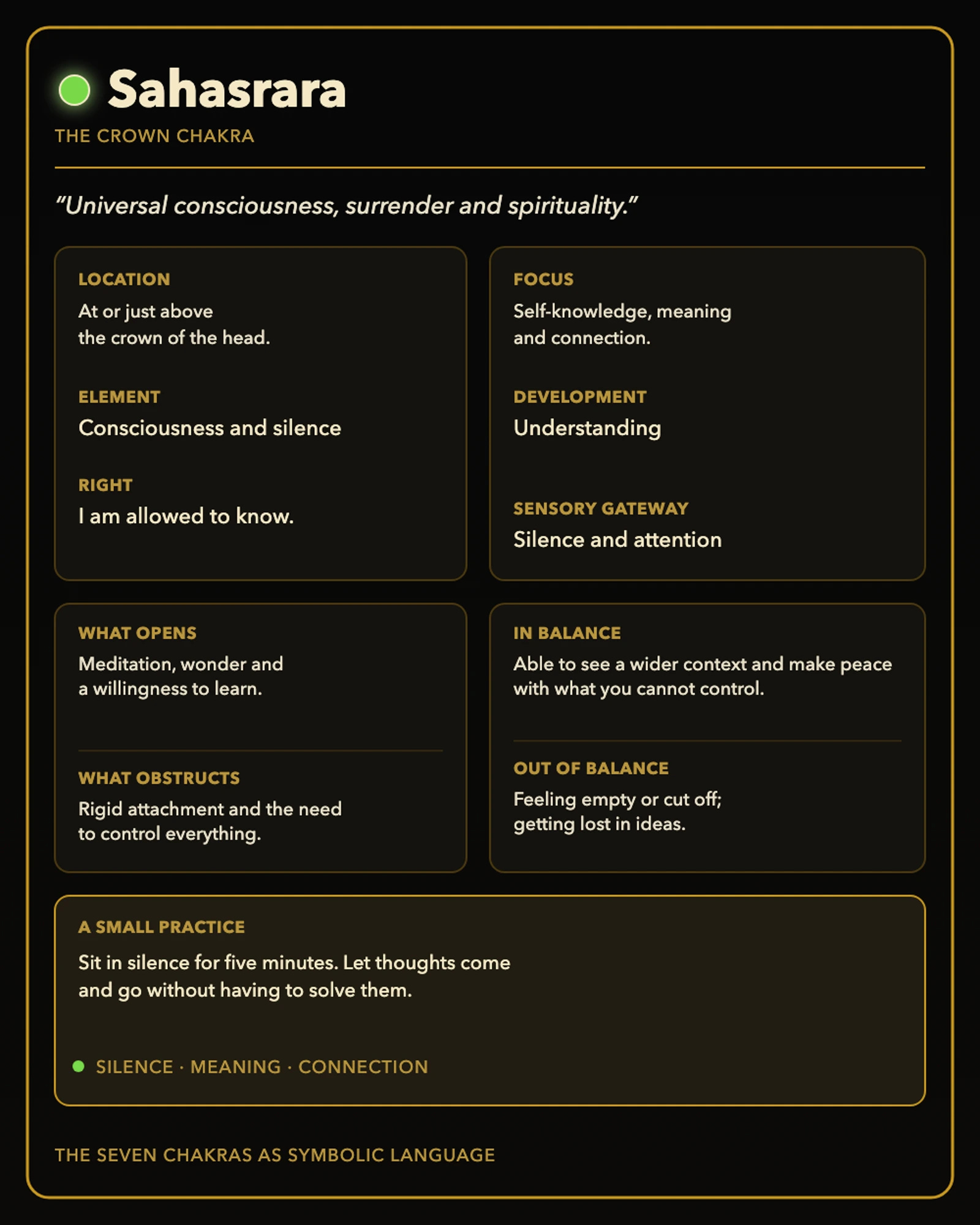
Sahasrara concerns self-knowledge, meaning and connection. The question is: can I connect with something larger than my immediate concerns without escaping reality? This is not about abandoning earthly life, but about not having to hold on to everything so tightly.
Here, surrender does not mean becoming passive. It means recognising that not everything can be made or controlled, and that control has limits. Meditation or silence can help you practise this: being present with what is, without immediately needing to solve or judge it.
When you remain open to new insights, other people and experiences you do not fully understand, there can be more room for understanding. This does not undo pain or loss, but it can help you place events in a wider context without losing yourself in grand ideas or abstractions.
Not everything has to be solved in order to live with it.
AUM, sound and mantra
Now that we have covered all the chakras, I would like to end with something interesting about AUM, which is also part of the De Rebus Method. You may recognise the symbol.

AUM has an important place within several Hindu and yogic traditions, but it is not linked to chakras in the same way in every tradition. It is not an extra chakra, nor is it “the solution” to every chakra. In Hindu and yogic traditions, it is a sacred sound -often written as OM - used in meditation and concentration. Repeating or chanting it can be a simple way to slow the breath and gather the attention.
The connection with chakras lies mainly in sound and mantra. In many modern yogic traditions, each chakra is associated with a *bija mantra*: a short sound that can serve as a point of attention during meditation.
Muladhara: LAM
Swadhisthana: VAM
Manipura: RAM
Anahata: YAM
Vishuddha: HAM
Ajna: OM or AUM
Sahasrara: often silence, sometimes OM
The exact arrangement varies by tradition. You do not have to treat these sounds as a fixed system that must be performed correctly. You can use them as a practical exercise: say or sing a sound slowly, pay attention to your breath, and notice what changes in your attention.
For that reason, AUM does not simply belong to one chakra. Within the approach of this article, it is better understood as an overarching mantra. In some contemporary systems, OM/AUM is associated with Ajna; with Sahasrara, the silence after the sound is sometimes emphasised.
In closing
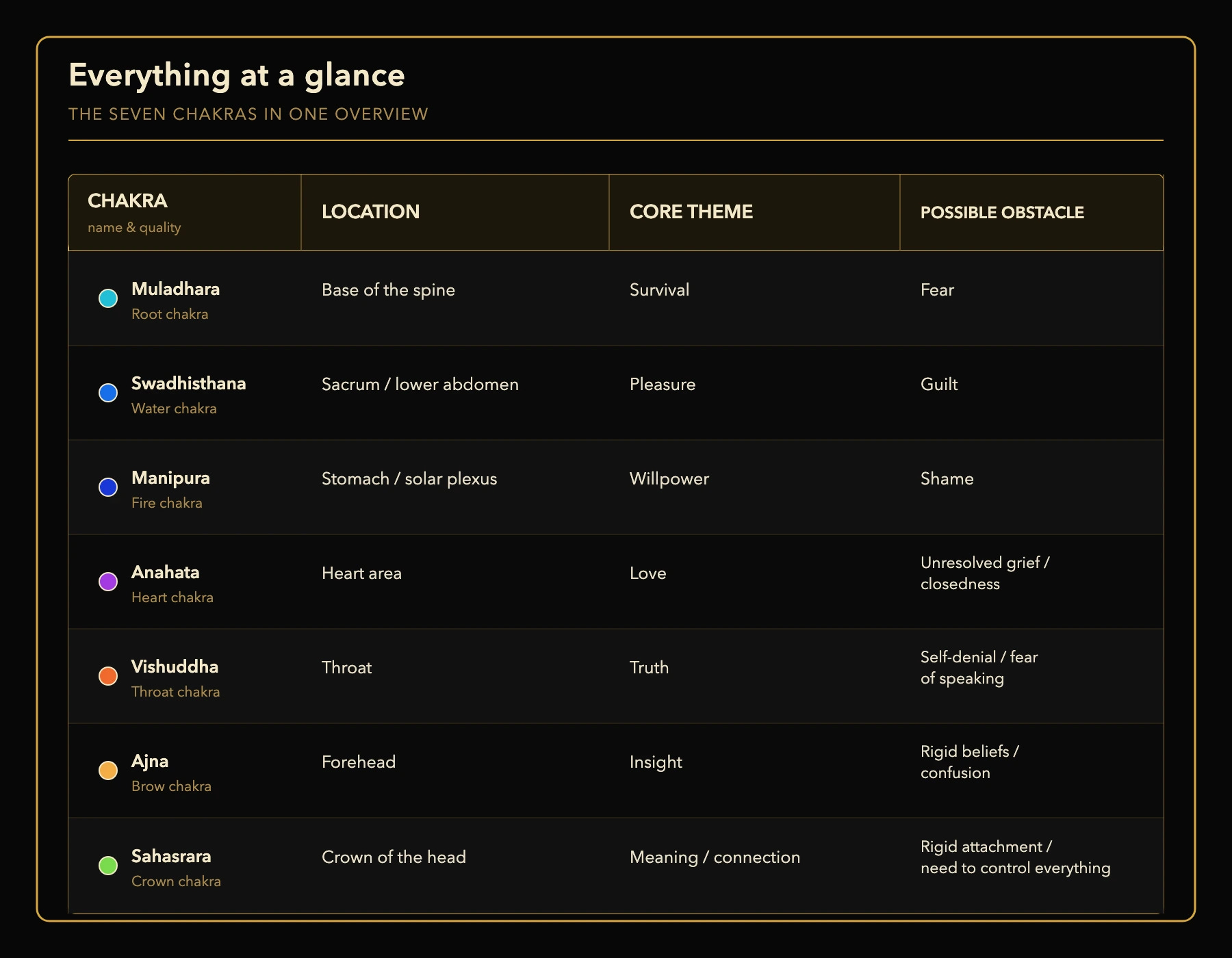
As you read at the beginning of this article, there is an enormous amount of information about chakras. Different traditions place different emphases, use different terms and approach the subject from different perspectives. Hopefully, this article has given you a clear overview of what the seven chakras can mean within this particular approach.
You do not have to see chakras as literal places or energy centres in order to find this map useful. Their value lies mainly in the questions they raise. Do I feel safe? Do I make room for what I feel? Do I dare to choose, love, speak and look at myself honestly?
You do not have to memorise or perform the mantras perfectly either. Think of them as an additional entry point: a sound, a calm breath and a moment of attention. Sometimes that can help you spend less time in your head and notice more clearly what is happening within you in that moment.
Perhaps you would like to carry one of these central questions with you:
- Do I feel that I am allowed to be here?
- Can I feel what is moving within me without immediately suppressing or judging it?- Do I dare to choose and take responsibility for what I want?
- Can I open myself without losing myself?
- Do I dare to make clear what is really going on within me?
- Can I look beyond my first interpretation?
- Can I connect with something larger than my immediate concerns without escaping reality?
You do not have to answer all of these questions at once. Choose one that touches something in you today. Take it with you on a walk, write a few lines about it, or simply pause with it for a moment. Self-inquiry does not begin with the perfect answer, but with the willingness to look honestly.