


In the Western world, we rarely start at the beginning. For example, no one really explains what we’re doing here. Of course, no one knows the definitive answer to that question. But there are certainly things we do know for sure. In this article, I attempt to bring them together.
Why is this useful?
By writing down what we do know for certain (or as close to certain as possible), we reduce the field of chaos. These observations serve as a kind of framework within which other conversations, questions, and ideas can take place.
The goal is for this article to continue evolving over the years. Whenever new observations, insights, or arguments prove to be sufficiently logical and fundamental to the human experience, they can be added to this list.
If you believe there is something that can be established with certainty, I’d love to hear from you at x.com/themythicus. If your contribution is added to the article, I’ll gladly credit you by name (unless you’d prefer to remain anonymous), allowing your contribution to become part of this growing body of thought.
What We Know for Sure
We know for sure that the Sun is hot.
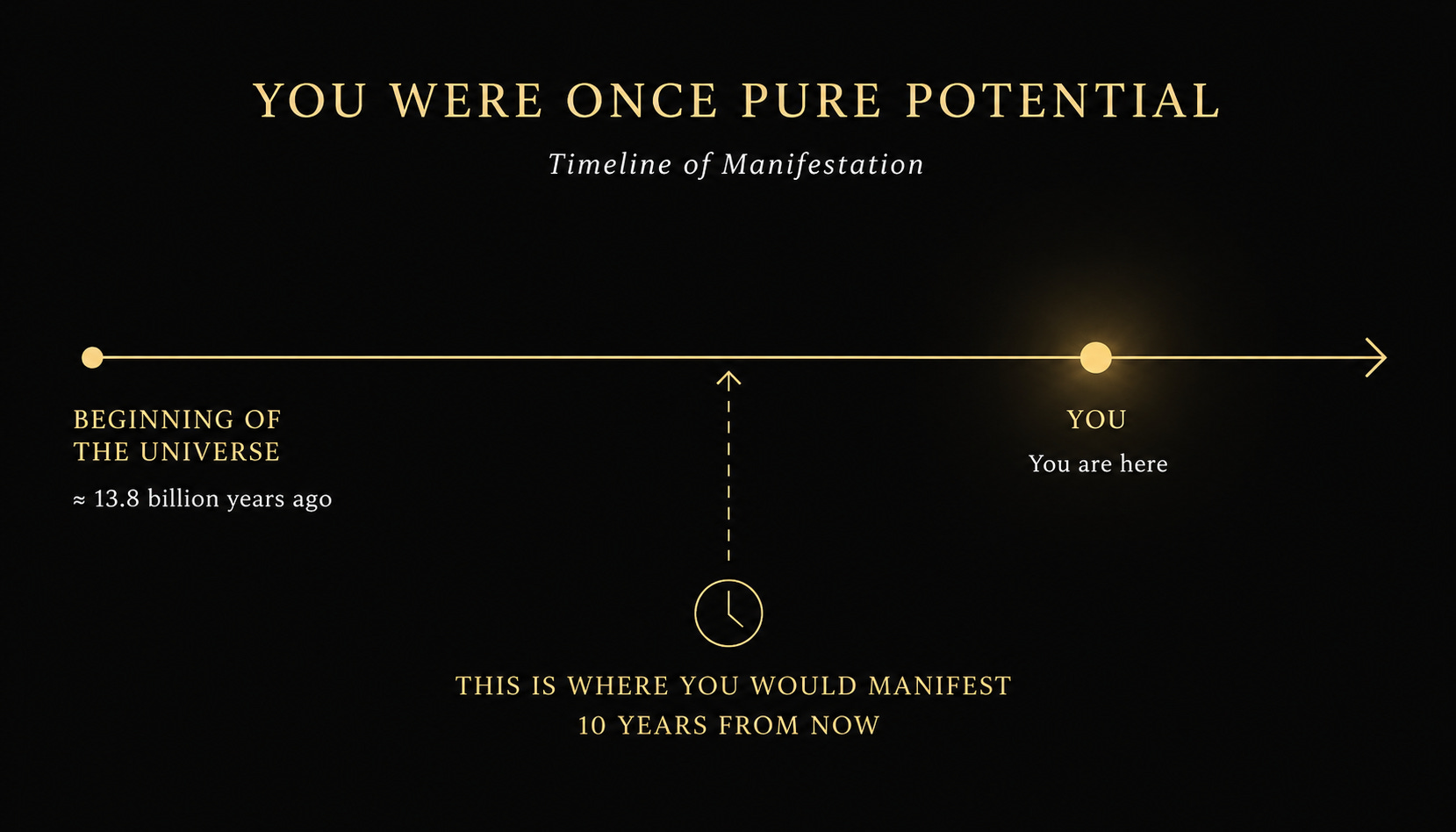
We know for sure that, ten years before your birth, you would come into existence ten years later.
We know for sure that the possibility of your existence already belonged to what we might call the field of potential.
According to modern science, the universe is approximately 13.8 billion years old. We also know that the possibility of your existence must already have been part of that field of potential. Otherwise, you wouldn’t be reading this now.
We know for sure that you are proof that your existence is possible.
We know for sure that masculinity and femininity exist.
We know that when they come together, new life can emerge. New bodies. And with them, the possibility of experience.
We know that, in most cases, human life begins through sexual intercourse (with exceptions such as IVF).
In that sense, we could also say that life is, in most cases, another phase of an orgasm.
From this, we cannot conclude that life has one fixed, universal purpose shared by everyone. But we can observe a recurring dynamic: the dynamic between Adam and Eve - between masculinity and femininity.
Finally, there is one thing you can say with absolute certainty: you exist. You are having an experience right now. What you cannot know with the same certainty is whether the people and world around you actually exist. That cannot be measured. In a dream, you may also believe that the world and everyone in it are real, only to wake up and realize that it was all a dream, and that only you had an actual conscious experience. If you find this question interesting, you may want to explore the philosophical concept of solipsism.
From Here, Philosophy Begins
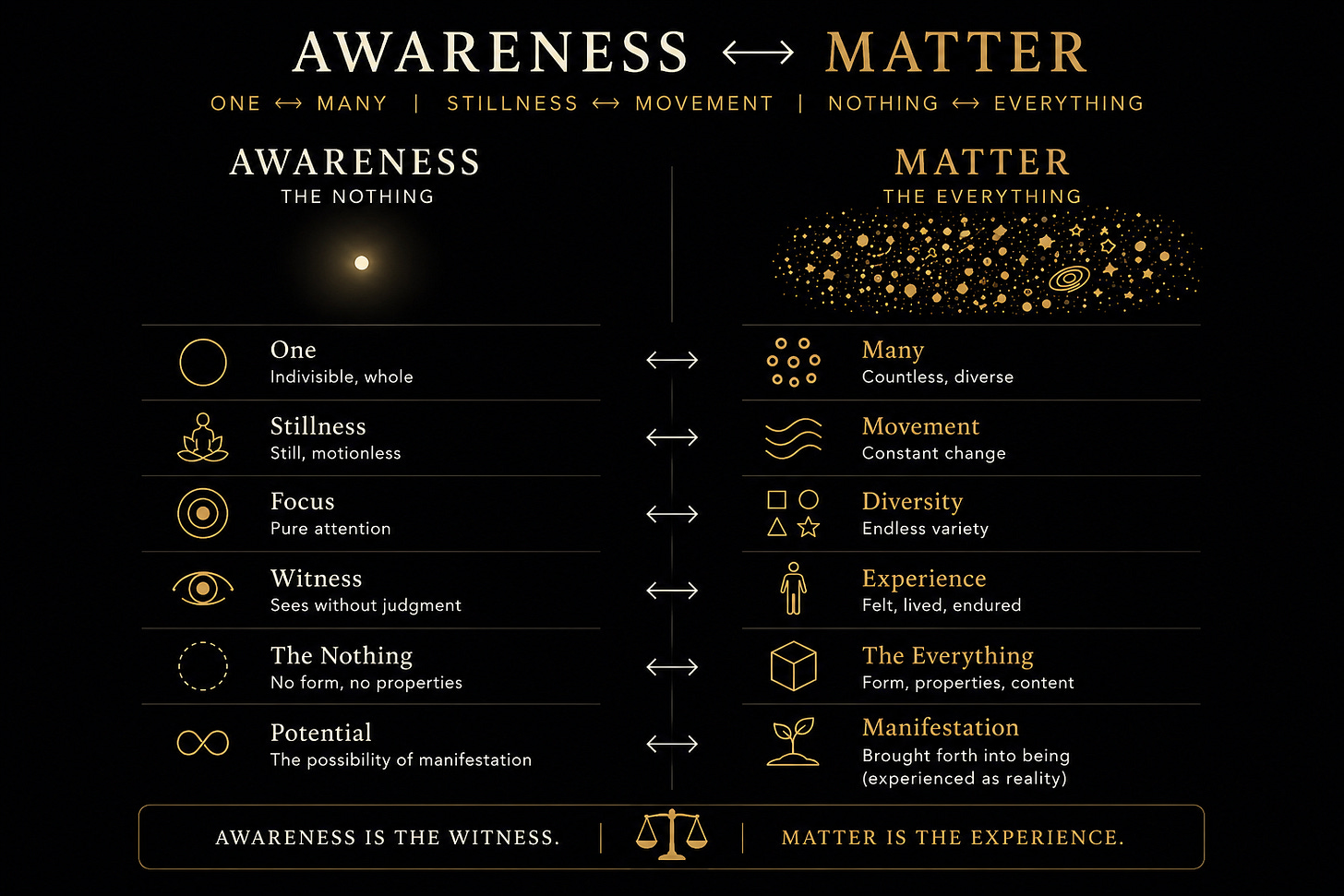
From this point onward, we leave the realm of certainty and enter the realm of philosophy. One question naturally follows: What is life? Could life itself be nothing more than the meeting of consciousness and matter? Matter without consciousness is simply matter - a rock, for example. But what about a plant? Does it possess consciousness? Or can life exist without it? And if consciousness exists at all, how could we ever hope to measure it?
Many aspects of reality appear to exist in complementary opposites: life and death, light and darkness, day and night, positive and negative. They seem to define one another. Perhaps consciousness and matter belong to that same category. If matter represents everything, could consciousness represent nothing? Not “nothing” in the sense of nonexistence, but in the sense that it cannot be pointed to. It has no location, no shape, no measurable properties - only the capacity to be aware. Could consciousness simply be that in which experience appears? That in which experience is witnessed? That in which experience ultimately dissolves? Wouldn’t that explain why consciousness itself has remained so elusive? Every attempt to observe it seems to reveal only the attributes of consciousness, never consciousness itself.
Let’s explore that possibility a little further. If matter is the domain in which emotion exists - where experience is generated, or perhaps more accurately, where experience is - could consciousness itself exist entirely without emotion? Could consciousness simply be awareness itself? Pure observation. Without judgment. Without preference. Without resistance. Nothing but attention itself. The witness. Interestingly, this closely resembles the way consciousness has been described throughout many spiritual traditions. In Hindu philosophy, for example, one finds the distinction between Purusha (pure awareness) and Prakriti (the material world).
Could consciousness therefore be described as Stillness Itself? Perfect equilibrium. The zero point. Completely undisturbed. Matter, by contrast, appears to be perpetual movement. Everything in the material universe is constantly changing. Molecules never stop moving. Energy never stops transforming. The exact configuration of any object exists only once before it is gone forever. In that sense, matter is continuously dying while simultaneously being reborn. Could matter therefore be understood as eternal change?
Beauty, too, seems to belong to the material world. One might object by pointing to music. But music exists through vibrating air, and air is matter. Even the appreciation of beauty takes place through a physical brain, a physical nervous system, and physical senses. Perhaps beauty, too, ultimately belongs to matter.
Can we say that the quality of being desired is more characteristic of the average woman than of the average man (consider the role of estrogen, physical beauty, the beauty industry, and the receptive nature of the egg cell)? Can we say that the quality of desiring is more characteristic of the average man than of the average woman (consider the role of testosterone and the active movement of the sperm cell toward the egg)?
This dynamic also seems to be reflected in the fundamental questions many men and women unconsciously carry within themselves. The average man (whose masculine pole is often more dominant) frequently struggles with questions such as: “Am I enough? Do I matter? Can I make an impact, provide direction, and protect what is important to me?” The average woman (whose feminine pole is often more dominant) often carries a different set of questions: “Am I loved and safe? Am I truly seen, appreciated, and free to be completely myself?”
These are not absolute rules, but archetypal tendencies. Every individual carries both energies within them. True fulfillment often arises when both aspects (the anima and the animus) come into balance, both within ourselves and in our relationship with others.
When we take a closer look at the process of reproduction, it becomes even more interesting. Throughout his lifetime, a man produces hundreds of millions of new sperm cells every day (approximately 1,500 to 3,500 per second, 90,000 to 210,000 per minute, and 5.4 to 12.6 million per hour). A woman, by contrast, is born with all the egg cells she will ever have.
The sperm moves. Wants something.
The egg waits. Is desired. Wants to be desired.
The sperm searches.
The egg selects.
The sperm represents an enormous amount of potential. The egg ultimately determines which potential manifests itself as life.
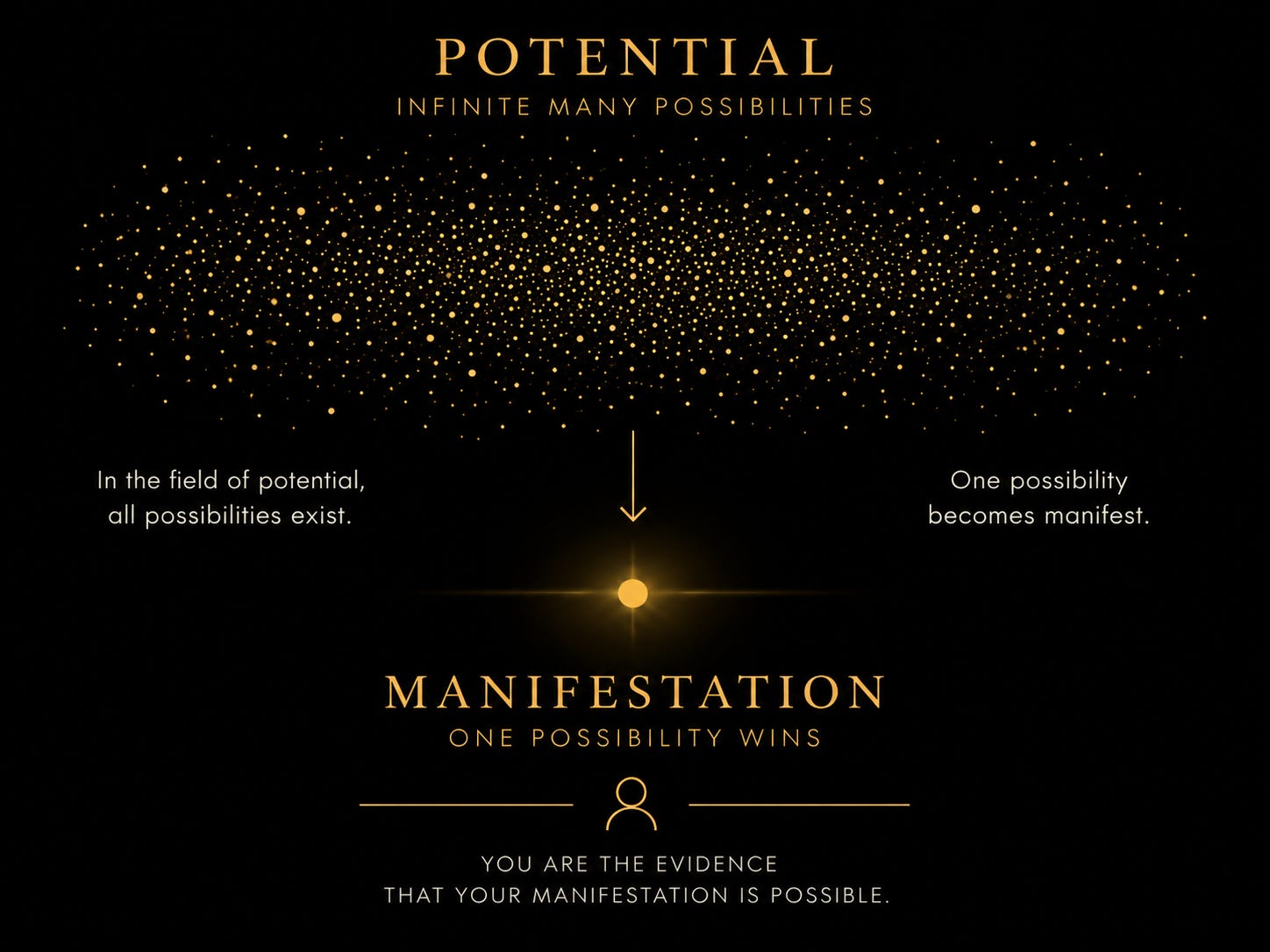
Millions of possibilities (approximately 100 to 300 million sperm cells per ejaculation) move toward a single possibility of manifestation. In the end, only one succeeds. And that one possibility is now reading this text.
Can we therefore say that masculinity symbolizes consciousness, while femininity symbolizes matter?
It is an interesting question. From this perspective, one could argue that the material world is fundamentally feminine - including the male body itself. If we look at reproduction in a fairly literal way, we could say that the masculine contribution, the seed, provides the element of consciousness, while the woman builds a body - matter - around it.
Could this have been where masculinity and femininity were to be found 13.8 billion years ago, before anything had ever manifested as life? When everything still existed only as potential in the ether? Femininity as matter, and masculinity as “the nothing”. That into which the universe expands. Could it look something like this?
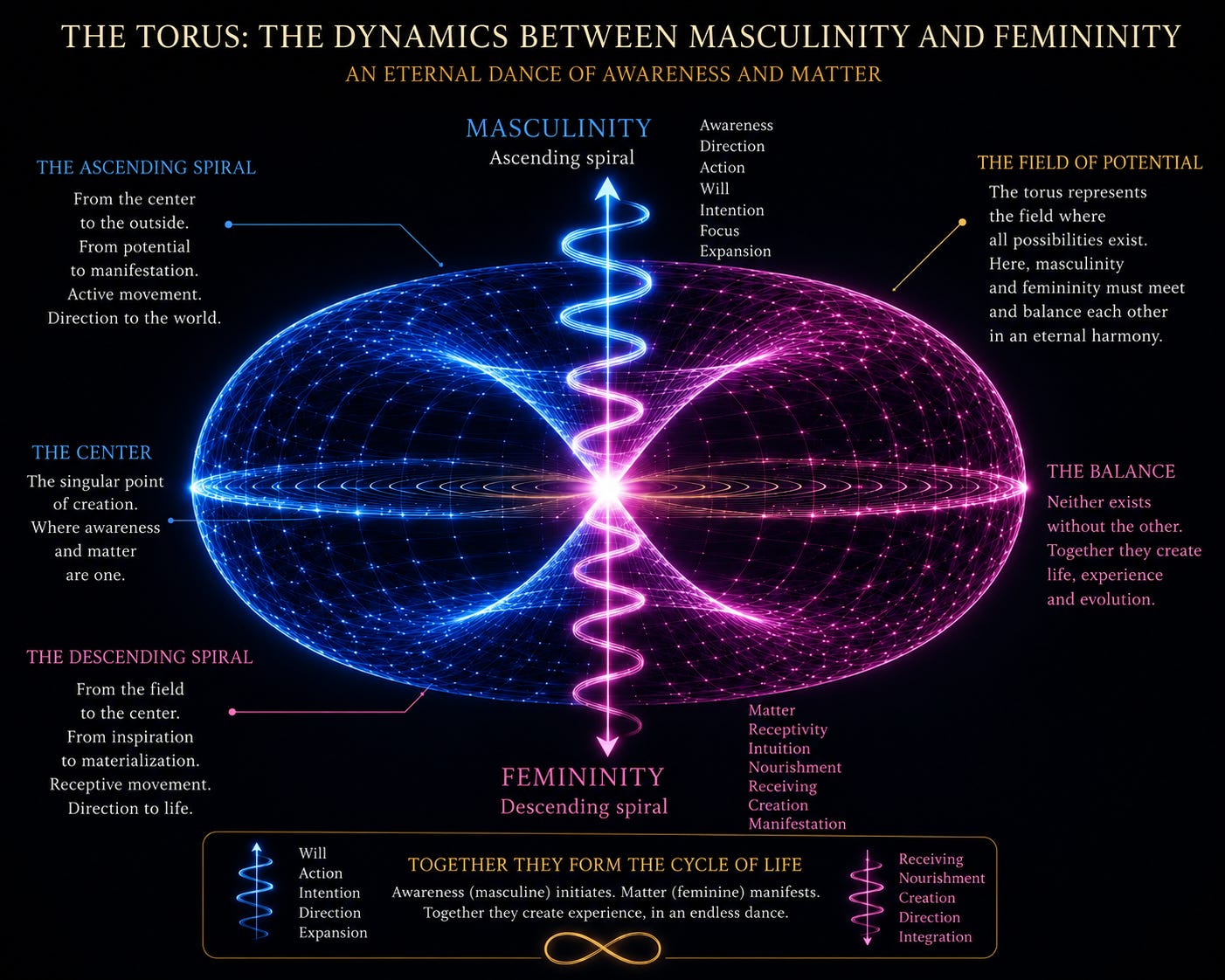
Be that as it may, creation itself is more directly connected to women than it is to men. This is because the possibility of experiencing creation is made possible through the body, and every human body is created and brought into the world by a woman.
From that perspective, one could argue that, for as long as we exist in manifested form, men are ‘visitors’ in Eve’s dimension.
Adam & Eve, Clothing & Conclusion
Remarkably, a woman has two X chromosomes (XX), while a man has one X and one Y chromosome (XY). Could it be that, on a symbolic level, the story of Adam and Eve is not so much about disobedience, but about the meeting of the masculine and feminine principles?
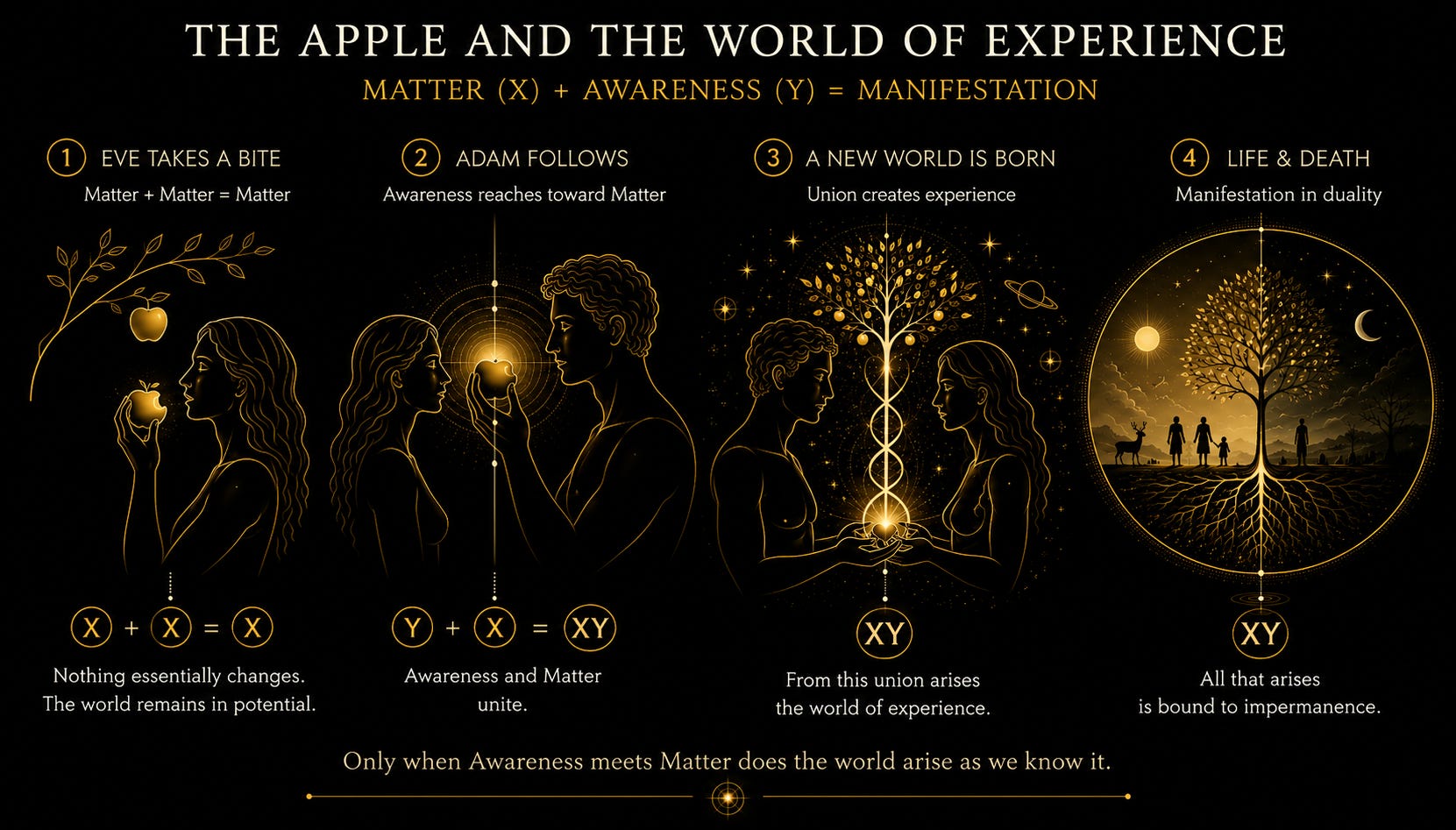
One could, for example, interpret it this way: Eve (X/Matter) first takes a bite of the apple (X), after which nothing fundamentally changes (Matter + Matter = Matter). Only when Adam (Y/Consciousness) follows does something entirely new emerge. It is as if the masculine principle (Y) unites with the feminine principle (X), giving rise to the world of experience, mortality, reproduction, and manifestation as we know it today (Matter + Consciousness > merged > create > Life & Death).
Of course, this is not a scientific or historical claim. It is merely a thought. A symbolic interpretation. Nevertheless, it is a remarkable one, considering that virtually everything in our existence seems to arise from the meeting of masculinity and femininity.
It is also interesting to observe the same dynamic reflected in clothing. Traditional men’s clothing often moves toward uniformity: the suit, the uniform, the toga. It is as though the masculine principle moves toward oneness. Women’s clothing, by contrast, generally allows for far greater variation in color, shape, texture, and diversity. Could this be another reflection of the same underlying dynamic that appears throughout reality? Consciousness as the One. Matter as the Many.

Perhaps the overarching purpose for each of us is simply to love one another. To hold on to Adam or Eve. Because, for as long as consciousness and matter remain unmanifested, such a possibility does not exist.
Have you ever felt closer to ‘the truth’ than during the moment you looked into the eyes of the person (Adam or Eve) you love?
🔮 Continue the exploration
If this article resonated with you, you may enjoy exploring these ideas further through The Rebus Method: a symbolic framework for observing experience, recognizing patterns, and deepening philosophical inquiry.
→ Discover the E-book