


There are moments when two people are in exactly the same room, yet do not inhabit the same world.
Imagine a birthday party. Music is playing, people are laughing, someone pours another drink. One person looks around the room and sees people who love him. He feels happy. Another sees the same room, hears the same voices, and can think only of the person who did not come. Or of a comment that landed badly.
The room is the same. The reality they experience is not.[^1]
We often say that thoughts are just thoughts. As though they exist somewhere above real life: little clouds drifting through our minds while the actual world simply carries on. But what if that assumption is not entirely true?
What if thoughts do not merely comment on reality, but help determine which reality we enter in the first place? What if an expectation helps determine what you notice, what you dare to do, which opportunities you can and cannot see, how your body responds to a situation, and what meaning an event ultimately acquires?
A thought does not have to be ‘true’ to have real consequences.
Gratitude then becomes something more interesting than a list of three positive things before going to sleep. Perhaps gratitude can be a way of influencing reality. Not by using your thoughts to bend the external world to your will, but by changing how you enter that world.
Maybe
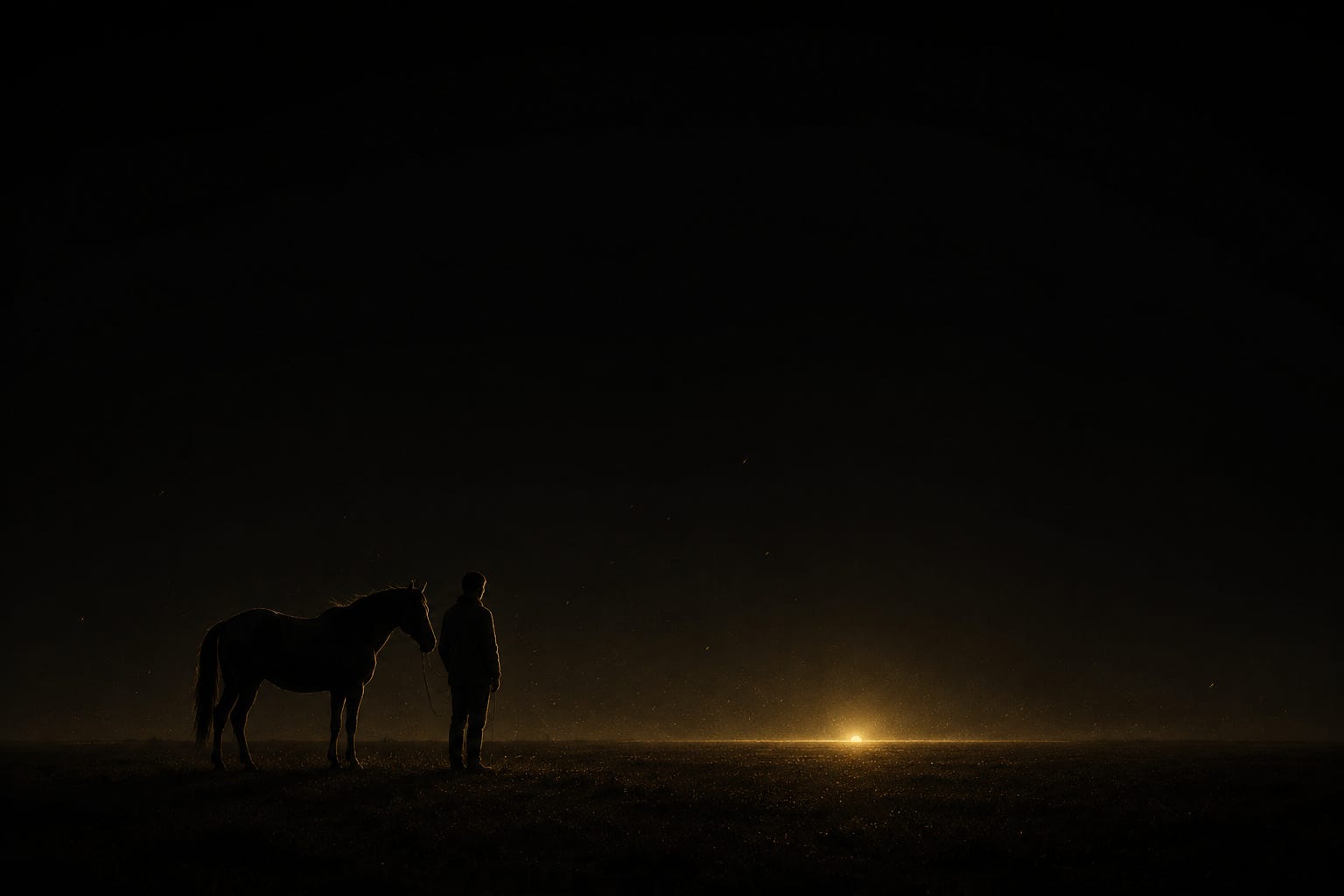
The ancient Chinese book Huainanzi contains a story about a man known for his calm way of looking at things.[^2]
One day, his horse runs away. In a world where a horse can mean transport, labour, and livelihood, this is no minor inconvenience. His neighbours come to console him. What a loss, they say. What terrible luck.
The man does not reply that it is not so bad. Nor does he say that everything happens for a reason. He asks only: Maybe. How do you know this is bad luck?
Some time later, the horse returns. It does not return alone, but brings another strong horse with it. Now the neighbours are at his door again, this time to congratulate him. What a stroke of luck. What good fortune!
The man asks the same question: Maybe. How do you know this is good fortune?
His son is excited by the new horse. He wants to ride it, falls, and breaks his leg. Once again, the neighbours see an obvious turn of events. First loss, then an unexpected gain, and now this. What terrible luck, they say.
Again, without triumph or reassurance, the father replies: Maybe. How do you know?
Two weeks later, war breaks out. Young, healthy men from the region are called up. Many do not return. The man’s son stays home because he cannot walk. What first appeared to be a disaster now keeps him out of the war.
The neighbours visit once more and say: How fortunate that he does not have to fight in the war! The father replies: Maybe. How do you know?
The story is often told as though it means that every misfortune eventually becomes good fortune. But of course, that is not a conclusion we can draw from it at all. The broken leg truly hurt. The war remains a catastrophe. The people who did not return do not suddenly become a necessary chapter in a beautiful story. Perhaps, a year from now, something will happen that makes the son wish he had gone. Perhaps not.
The power of the story lies elsewhere. The man is not indifferent, nor is he predicting the future. He simply refuses to turn an event immediately into a final judgement on his life. He does not say that the neighbours are wrong. He only says that they are rather quick to draw conclusions.
What You Think Is Real
There is a well-documented study by the Italian nocebo researcher Fabrizio Benedetti.[^3] Before a journey to an altitude of 3,500 metres, one participant was given information about the possibility of ‘high-altitude headache’. That message was then passed on to 35 others. A control group of 38 people did not receive the warning.
On the mountain, 31 of the 36 people in the warned group reported headaches, compared with 20 of the 38 people in the control group. Their headaches were also more severe. Greater increases in prostaglandins and thromboxane (substances involved in the pain response) were measured in the saliva of the warned group. Only that group also showed an increase in the stress hormone cortisol.
It reveals something fascinating. The words did not make the mountain any higher. They did not create the low-oxygen environment. Nor did they make the real physical strain imaginary. The expectation intensified what happened on that mountain, both in the experience of pain and in a measurable physiological process.
The underlying phenomenon is called the nocebo effect: a negative expectation or treatment context can trigger or intensify symptoms. A later meta-analysis of 130 studies found such effects across a range of physical outcomes, although their strength varied considerably depending on the symptom and the way in which the expectation was induced.[^4]
That distinction matters. A thought does not have to create matter out of nothing to influence reality. It only has to interact with what is already there.
What does this tell us about the power of our thoughts and expectations? Does it work the other way around as well? Could it be that if I can feel a form of gratitude for experience itself, even when that experience is not entirely pleasant, this can have a positive and measurable influence on my life?
From this, you could argue that the power of gratitude lies in recognising that attention, expectation, and meaning help determine which possibilities open up to you within this world.
It can be liberating not to treat a thought as an immediate verdict. It is a first impression. An automatic response. A first reading. A possible story.
Maybe.
That single word expands the realm of possibility.
Hell and Heaven in the Same Situation
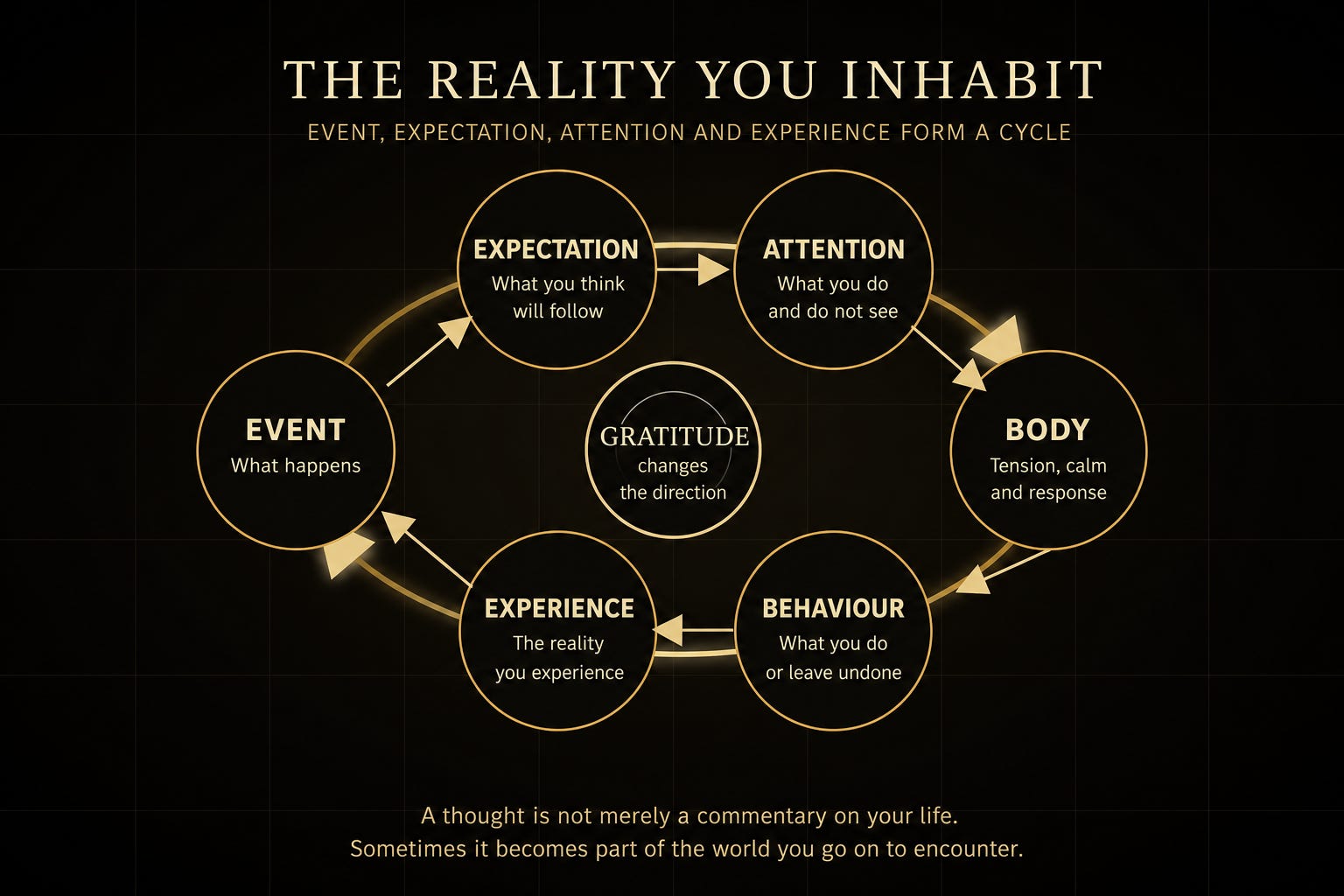
Perhaps you recognise this: you wake up and do not feel well. Your body is tired. Your mind is full. Something is scheduled that you are dreading. On mornings like these, it can feel as though everything is conspiring against you. The weather is grey. Someone responds curtly. Your coffee has gone cold. A bill arrives. Everything seems to provide evidence for the same conclusion: this is a bad day.
But imagine waking up on that exact same morning with a different point of departure. Not: why does all of this have to happen to me? But: I am still here. I have a body capable of feeling tired, which also means it carried something yesterday. There is coffee. There is water from the tap. Apparently, there is still a day in which I can do, say, make, or change something.
The rain remains rain. The bill does not disappear. The person who was curt does not suddenly become warm and loving. And yet, you are no longer living in exactly the same reality.
Your attention is constantly making selections. You cannot see everything at once. When your attention is completely consumed by lack, danger, rejection, or disappointment, it becomes almost impossible to notice what is also there: the friend who did call last week, the fact that music exists, the fact that your legs can carry you outside, the possibility of sending someone a message, the sun that continues to illuminate the entire world even behind a dense layer of cloud.
Gratitude does not say that the bad does not exist. Gratitude says something more like this (perhaps a little ‘corny’, but no less true for it): maybe the glass actually is half full.
That is different.
Perhaps gratitude is therefore not primarily an emotion. Perhaps it is the direction in which you look. A tendency towards the positive, as it were. A choice for optimism.
The World as a Mirror of Your Inner State
When you see the world as a hostile place, you walk differently. You speak differently. You look at people differently. You are quicker to be on your guard, quicker to interpret a remark as an attack, quicker to withdraw before anyone has the chance to reject you.
And then something interesting happens. People often sense that reserve and become more cautious as a result. Less open. The world then appears to confirm what you already believed: see, people are distant. Your expectation influences your attitude. Your attitude influences the other person. Their response then becomes evidence for your original expectation.
I think, for instance, that you are more likely to stub your toe on a day when you are already in a terrible mood than on a day when you feel good. You move more hurriedly, you feel the opposite of relaxed, and every inconvenience fits seamlessly into the story that the day was already against you. When we are angry, we often say or do things we later regret. When we have inner peace, this rarely happens.
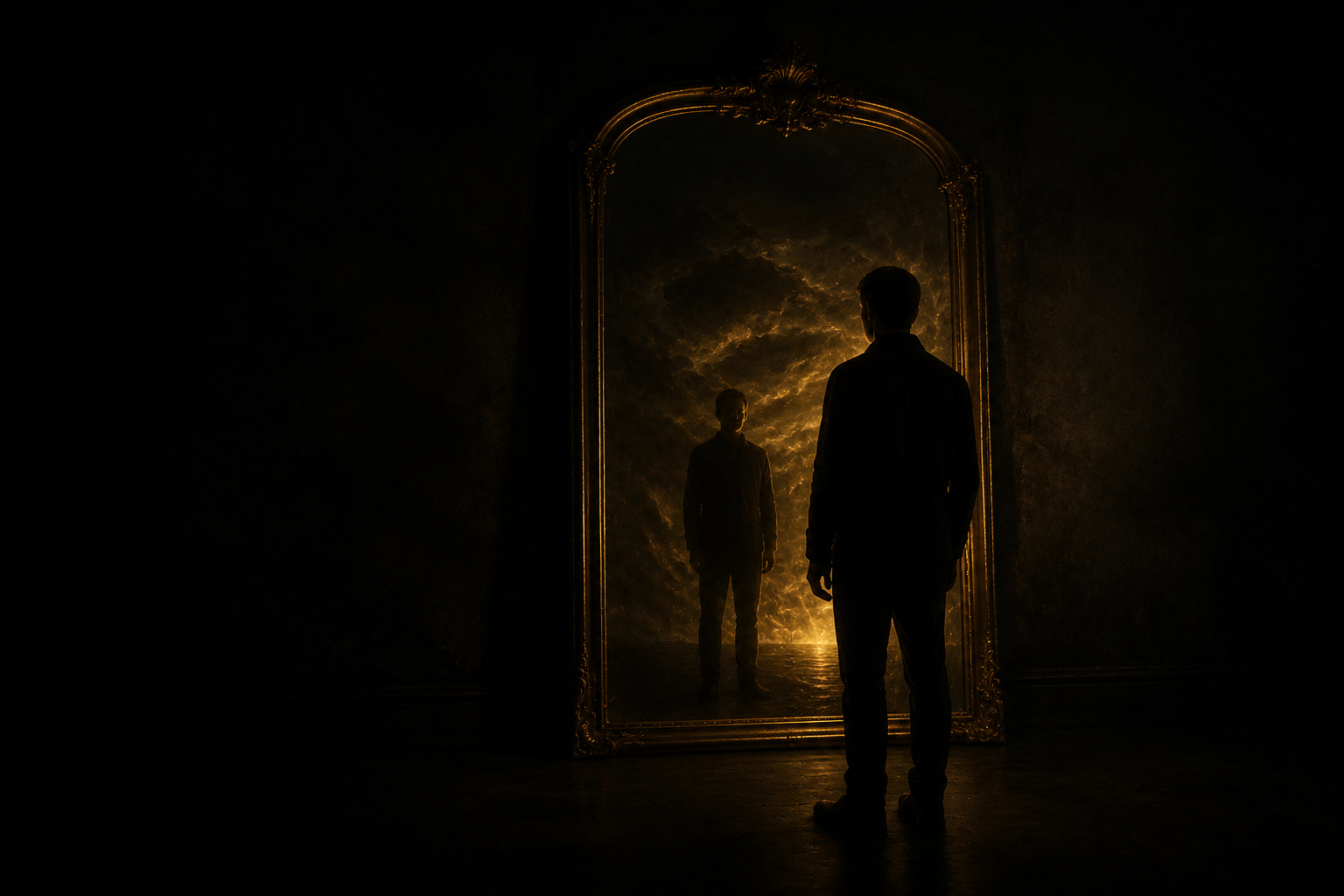
The mirror cannot judge you. You judge what you see in the mirror. Let the world be your mirror. Perhaps you do not need to judge less, but to judge differently.
When you assume that there is nothing for you, that you are always lacking something, or that the world owes you something, you mainly see whatever fails to meet that expectation. When, on the other hand, you look for what is already there. Not as an exercise in self-deception, but as a genuine intention. You become more likely to recognise and create connections, to see and seize opportunities, and, for example, to dare to give something back to another person.
Can someone with few possessions, but with the ability to notice beauty, help, time, friendship, and life itself, experience a richer life than someone who possesses a great deal but can see only what is missing?
More, more, more, more, more?
Gratitude for Experience Itself
This is where things may become a little stranger.
We are grateful when something goes well. That makes sense. Someone helps you, you are given an opportunity, your body feels healthy, you fall in love, or you hear a song that says exactly what you yourself had not yet been able to put into words.
But can we also be grateful for the fact that we are capable of experiencing anything at all? If you were given the choice, would you want to numb human sensitivity so completely that you could no longer feel pain, if doing so also made love, the capacity to be moved, and connection unreachable?
Perhaps not.
Perhaps this is also what non-duality points towards, in a certain sense: that we often try to remove parts of life that are inherently bound up with it. Sadness is not allowed to exist. Fear is not allowed to exist. Uncertainty is not allowed to exist. The inevitable end is not allowed to exist.
But they do.
Resistance to injustice can be necessary. But resisting the mere fact that an emotion exists in this moment can add a second layer on top of it: fear of fear, shame about shame, anger because the anger is still there. Perhaps space emerges only when we no longer demand that experience be different before we are willing to live. Resistance prevents emotions from having the space to ‘dissolve’. Embrace and receive; holding on holds you back.
Gratitude can mean: this, too, is part of life, and that is okay.
Past, Present, and Future
Thoughts, emotions, and actions form a triangle of influence. What you think affects how you feel and act. What you do can change your mood and self-image. And how you feel helps determine which thoughts sound believable.
Deciding to eat better, exercise more, or finally have that one conversation does not guarantee that you will immediately feel better. But an action can bring movement into a system that appears to be stuck. A different emotional state can then make different thoughts accessible. And those thoughts can, in turn, lead to different choices.
Harmony between thoughts, emotions, and actions arises from:
Gratitude for the present.
Trust in the future.
A Reference to The Rebus Method
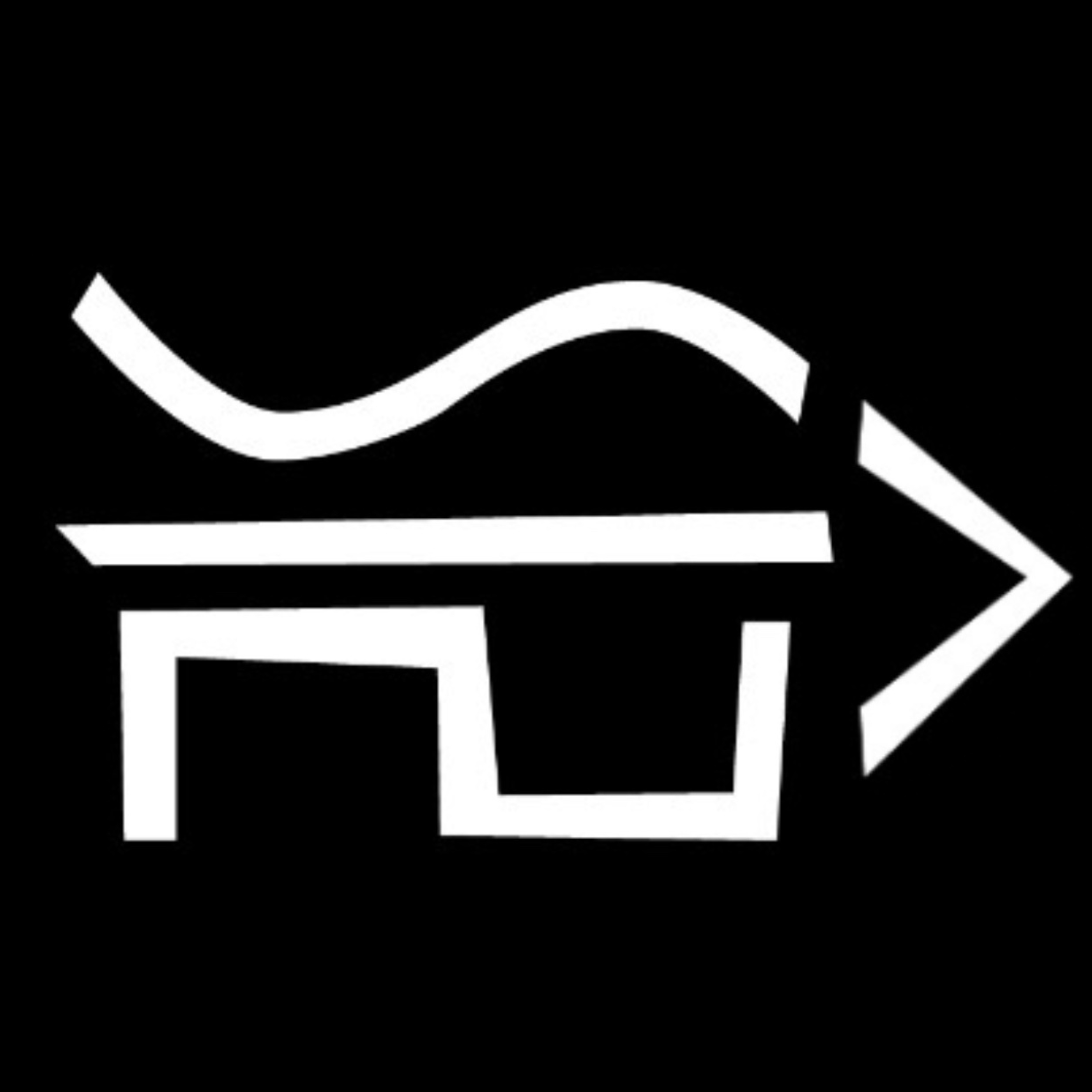
When you look at the symbol above, you direct your attention towards your Thoughts and Actions. Thoughts always move through time:
The winding line at the top represents the Future: expectations, hope, worries, or trust.
The straight line in the middle represents the Present: the only moment in which you can take action.
The segmented line at the bottom represents the Past: memories, reflection, regret, or acceptance.
The > symbol on the right represents Actions: the choices you make based on your emotions and Thoughts.
Want to know more? Read more about The Rebus Method here
1. Accepting the past
As long as you do not let go, you cannot accept the past. As long as you do not accept the past, you can never be content with where you are in this moment. If you cannot feel gratitude for the present, you cannot have trust in the future either.
As long as you continue to negotiate with the fact that something happened, the present becomes a kind of courtroom in which the past is put on trial again every day. The question is not whether you can somehow call the past good after all. The question is what relationship you want to have with it today.
2. Being grateful for the present
The present is the only reality that actually exists. As long as you are not grateful for the now, you are living either in memories or in worries. Gratitude brings you into harmony with the moment and gives you peace, because you lack nothing and need not force anything.[^5]
3. Trusting the future
The ability to feel gratitude at any moment gives you trust in the future. You know that, whatever happens, in a future present you will still have the capacity to be grateful for that moment and everything it contains. That is where trust lies. And trust removes every limitation.
Revising the Verdict
“Maybe” breaks the verdict open. Gratitude determines what happens next with the space it creates. Gratitude is not the pleasant feeling that arises when life finally meets your expectations. When gratitude depends on a desired outcome, you can be grateful only for as long as you get what you wanted. That is not gratitude. That is conditional satisfaction. And by doing so, you give the external world complete authority over your inner state.
True gratitude is inner independence. Not the denial of pain, loss, or injustice, but the refusal to let what happens to you determine the meaning of your existence as well. That is why gratitude is the key. Gratitude makes acceptance of the past possible, because what happened no longer defines the present in its entirety. Gratitude places you in the present, because you stop waiting for reality to finally meet your conditions. And gratitude gives you trust in the future, because your inner peace is no longer entirely dependent on a particular outcome.
Every future eventually becomes a new present. There, too, you once again possess the ability to look, to choose, and to relate to life. You do not need to control the future when the future no longer determines your inner freedom. The Christian image of Jesus on the cross takes that idea to its furthest extreme: his body is at the mercy of the external world, but his inner focus remains fixed on God. That is the peace many are searching for: not a life in which nothing can touch us, but an inner state that is not entirely governed by our autopilot response to what happens to us in the external world. The external world can touch you, wound you, and take a great deal from you. Gratitude does not deny that. Gratitude merely deprives the external world of the power to determine your inner peace entirely.
And that begins with the most undeniable fact of this moment: you are breathing. Gratitude for your breath rests not on a belief, but on a fact. Without that breath, no thought, memory, fear, love, or any other experience is possible.
That is the power of gratitude.
Lux et Veritas,
The Mythicus
🔮 Continue the exploration
If this article resonated with you, you may enjoy exploring these ideas further through The Rebus Method: a symbolic framework for observing experience, recognizing patterns, and deepening philosophical inquiry.
→ Discover the E-book
Sources
Yeo, G. C. & Ong, D. C. (2024). “Associations between cognitive appraisals and emotions: A meta-analytic review.” Psychological Bulletin, 150(12), 1440–1471. https://doi.org/10.1037/bul0000452
Huainanzi, Chapter 18, “Human Conduct and Instruction”. The passage is a free retelling of the story in the Huainanzi, compiled in the second century BCE. Chinese source text and translation: https://ctext.org/huainanzi/ren-xian-xun#n3395
Benedetti, F., Durando, J. & Vighetti, S. (2014). “Nocebo and placebo modulation of hypobaric hypoxia headache involves the cyclooxygenase-prostaglandins pathway.” Pain, 155(5), 921–928. https://doi.org/10.1016/j.pain.2014.01.016
Rooney, T., Sharpe, L., Todd, J., Tang, B. & Colagiuri, B. (2024). “The nocebo effect across health outcomes: A systematic review and meta-analysis.” Health Psychology, 43(1), 41–57. https://doi.org/10.1037/hea0001326
Choi, H., Cha, Y., McCullough, M. E., Coles, N. A. & Oishi, S. (2025). “A meta-analysis of the effectiveness of gratitude interventions on well-being across cultures.” Proceedings of the National Academy of Sciences, 122(28), e2425193122. https://doi.org/10.1073/pnas.2425193122